Dialogue | Wu Changshuo’s great-grandson talks about his great-grandfather and Shanghai: the power of the stone, the heart of the grass.

"Jin Shili Grass Heart-Wu Changshuo and Shanghai" has been exhibited at the China Art Palace (Shanghai Art Museum) since February 10, 2021. The exhibition focuses on the relationship between Wu Changshuo and Shanghai-style art and Shanghai. For the first time, it has gathered from Shanghai Museum, Zhejiang Museum, Hangzhou Xiling Printing Society, (Anji) Wu Changshuo Memorial Hall, Shanghai Wu Changshuo Memorial Hall, Shanghai China Painting Academy and their families. From Wu Changshuo’s 23-year-old seal script and his 36-year-old plum blossom painting to his masterpiece in his later years, we can also see how Wu Changshuo’s stone brush runs through, and also see Wu Changshuo’s friends and artistic life.

"The Paper Art Review" (www.thepaper.cn) recently talked with Wu Changshuo’s great-grandchildren Wu Chao and wuyue, who are currently the directors of Shanghai Wu Changshuo Culture and Art Foundation and the executive curator of Wu Changshuo Memorial Hall respectively. Their father Wu Changye is the child held by Wu Changshuo in the well-known old photo of Wu Changshuo’s family portrait, and they also grew up listening to Wu Changshuo’s story, but now they have changed from storytellers to storytellers.
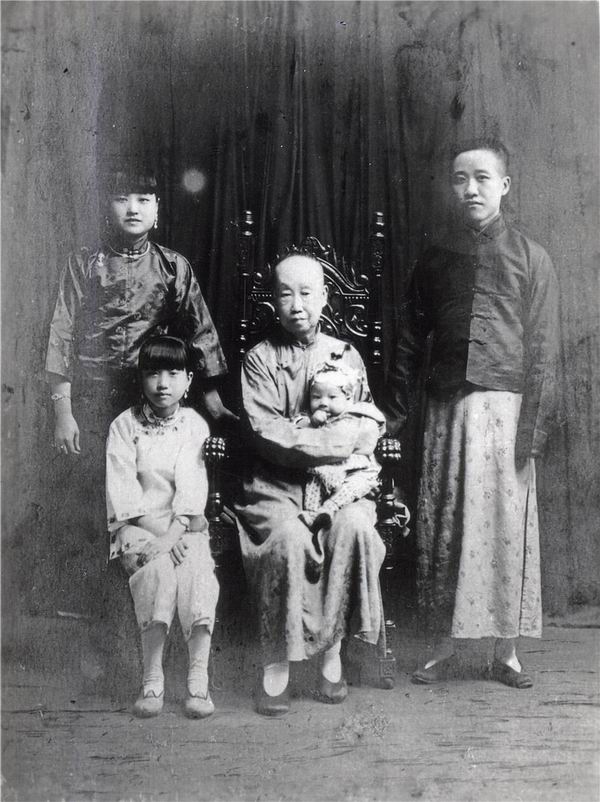
Wu Changshuo and his son Wu Dongmai, and their granddaughters Wu Diying and Sun Wu Changye (holding hands) took a group photo.

Wu Changshuo and Shanghai

The Paper: In this special exhibition "Wu Changshuo and Shanghai", the works are borrowed from Shanghai Museum, Zhejiang Museum, Xiling Press and many other cultural institutions. Many works are also exhibited in Shanghai for the first time. Is there any emphasis on the selection of exhibition works?

Wu Chao:The preparation time for this exhibition is relatively tight, and we have received strong support from Xiling Printing House, Zhejiang Museum, Shanghai Museum, Shanghai Wu Changshuo Memorial Hall and Shanghai China Painting Academy. Some of the works on display were donated by our family to Xiling Printing House and Zhejiang Museum. As members of Xiling Printing House, our family will donate some collections to Xiling Printing House and all the places where Wu Changshuo Memorial Hall was established, from which we can see the support of the Wu family, who has spanned four generations, to the memorial sites in Wu Changshuo.

In this exhibit, some of Wu Changshuo’s poems and letters are on public display for the first time, including the eight-meter-long regular script and scroll landscape paintings collected by Zhebo. Even more, Mr. Wang Yiting painted Xiang sister for Wu Changshuo, and Mr. Wu made a long topic about this painting, from which we can see that Mr. Wu Changshuo has always had deep feelings for his hometown and childhood from his youth to his success, and his works are always full of such rich humanistic spirit.
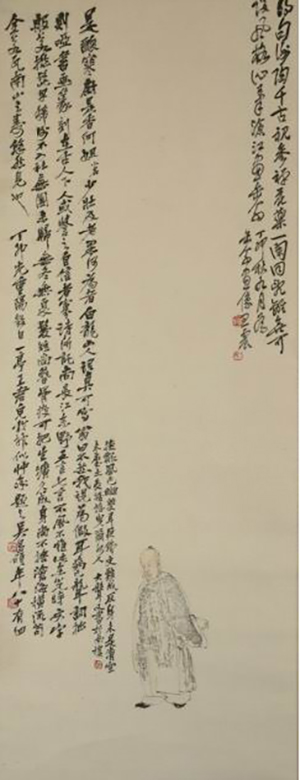
Wu Changshuo, Xiang sister, 1927, private collection.

Wuyue:Many people think of Mr. Wu Changshuo as a flower painter. But in fact, his paintings are very extensive. In this exhibition, you can see animals such as tigers, cranes and deer, as well as figure paintings and landscape paintings written by Mr. Wu Changshuo. The calligraphy on display includes Mr. Wu Changshuo’s calligraphy works from the age of 23 to 84, while the paintings are from the age of 36 to 84. The content of calligraphy style is also very rich, such as Zhang Caoli seal and stone drum.

Han Juan of Landscape Poems, 1919, Zhejiang Provincial Museum.

Han Juan of Landscape Poems, 1919, Zhejiang Provincial Museum.

Han Juan of Landscape Poems, 1919, Zhejiang Provincial Museum.

Zhejiang Museum will lend some of its collections for free this time. When we select exhibits, we pay attention to few but fine, and cover a wide range, so that everyone can feel the comprehensiveness of Mr. Wu Changshuo’s art. In addition to calligraphy and painting, there are also letters and Four Treasures of the Study. The coverage and span of this exhibition can be said to be unprecedented. The exhibits we chose this time are also rare works. Take advantage of the momentum of the first exhibition of the Year of the Ox in the Chinese Art Palace, carry forward the spirit of Wu Changshuo, inspire the people through culture, and let everyone feast their eyes.
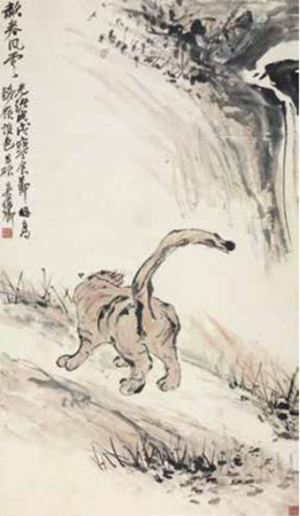
Wu Changshuo, "The Wind and Cloud Map of Lingao Qipei Xiao Juan" (Axis), collected in Zhejiang Provincial Museum in 1898.
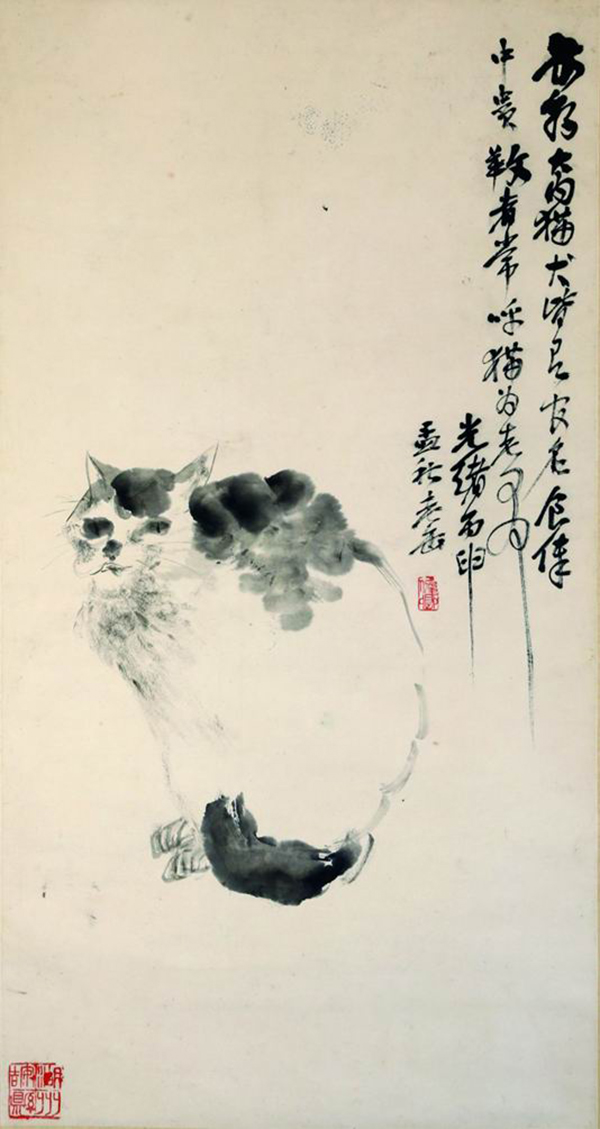
Wu Changshuo, Cat (Axis), 1896, private collection.

The Paper: The exhibition is called "Wu Changshuo and Shanghai". What did Shanghai bring to Wu Changshuo and what did Wu Changshuo bring to Shanghai?

Wuyue:Mr. Wu Changshuo and Pudong have an indissoluble bond with Shanghai, where he made friends such as Li Pingshu and Chen Guichun, and also participated in the establishment of Oriental Hospital. As an artist, he not only guided the development of Shanghai culture in the art field, but also had a strong humanistic spirit.

One of the works in the exhibition, Peony Flower, is a collection of Anji Wu Changshuo Memorial Hall. This work is related to Pudong. Around 1900, Wu Changshuo often went to Pudong flower garden to watch flowers, and when he returned home, he spread paper and painted them. Peony and peony written by Wu Changshuo were commonly known as "local flowers" by Shanghainese. Last year was the 30th anniversary of Pudong’s development and opening-up, and we also held the activity of "130th anniversary of Wu Changshuo’s attachment to Pudong", so we borrowed this work.
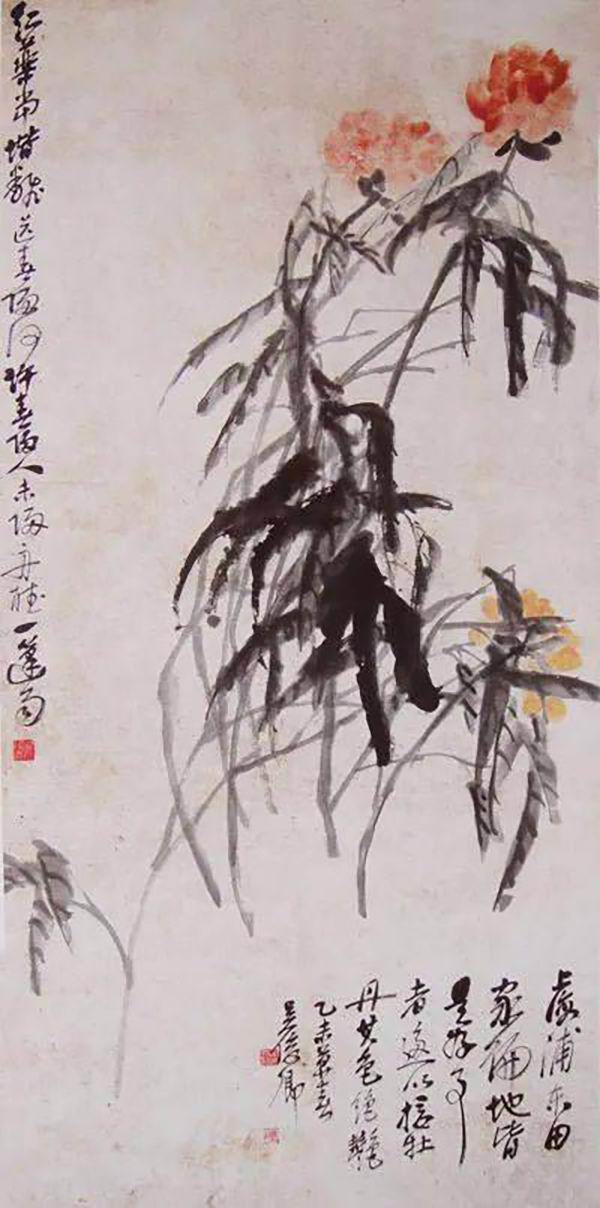
Wu Changshuo, Flower Map of Peony in Pudong, 1894, (Anji) Wu Changshuo Memorial Collection.

In 1909, Wu Changshuo, Mr. Qian Huian and Mr. Wang Yiting founded the Yuyuan Garden Calligraphy and Painting Society, which was the first charity organization in Shanghai painting circle. We can know from the recent historical materials that Mr. Chang Shuo provided support for the May 30th Movement under the leadership of the Communist Party of China. He also trained a large number of outstanding disciples in Jiqingli on the northwest road of Shanghai Mountain. In this narrow world, he has walked out of Pan Tianshou, Liu Haisu, Wang Geyi and other famous figures in the field of calligraphy and painting seal cutting. Mei Lanfang and Xun Huisheng once worshipped him. Mr. Wu Changshuo is engaged in artistic creation and training his disciples in Shanghai, a land full of rivers and seas. The disciples spread his thoughts and made positive contributions to cultural development.
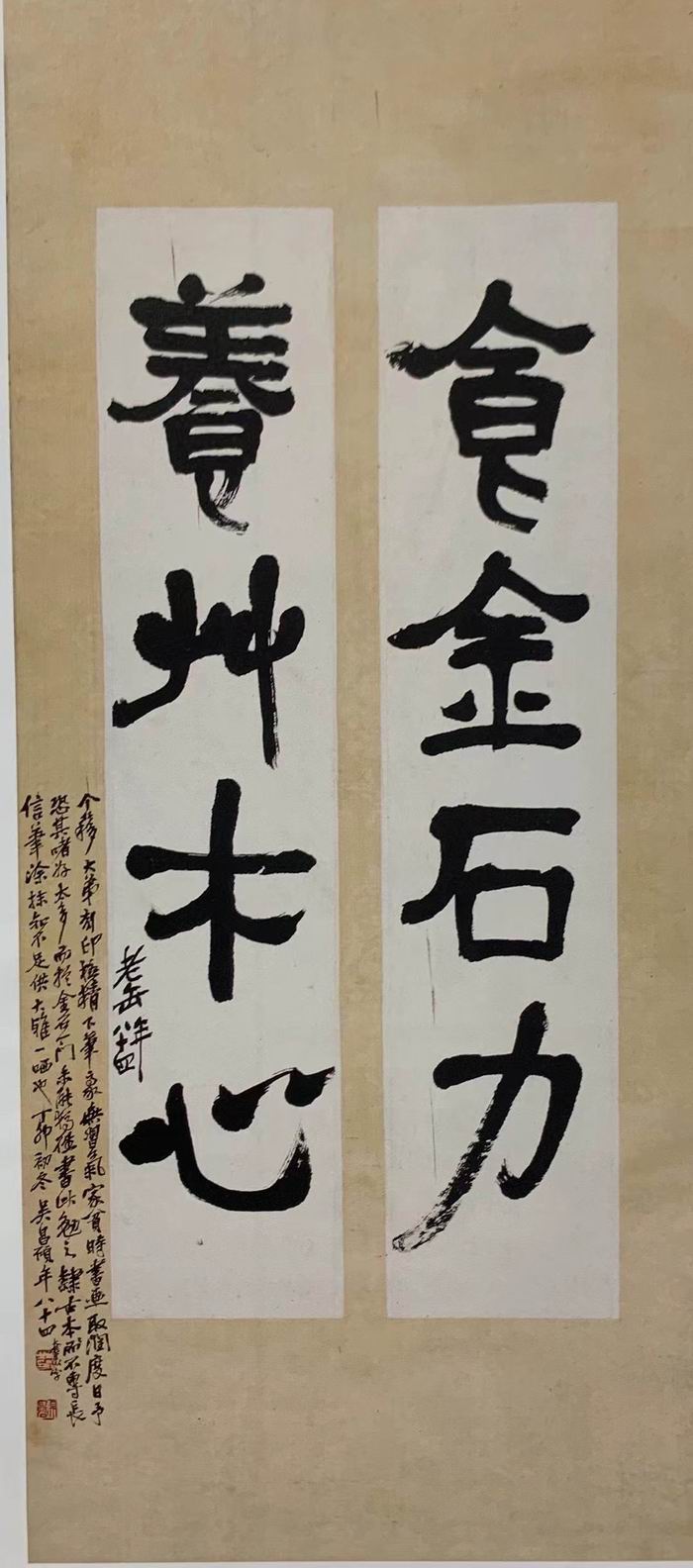
Wu Changshuo, Li Shu Si Yan Lian, 1927, collected by Xiling Press.

Wu Chao:Shanghai provides Mr. Wu Changshuo with a creative platform. At that time, Shanghai style painting and calligraphy were divided into "pre-Shanghai style" and "post-Shanghai style". In the late Qing Dynasty, the "Pre-Shanghai School" prevailed, which was characterized by exquisite brushwork of calligraphy and painting. After the Revolution of 1911, the emperors from Beijing and other former literati left for the south, bringing a "golden stone wind". Wu Changshuo’s poetry, calligraphy and painting are all printed, and his painting style comes from "printing", including his evolution of Shi Guwen into a stone drum body with his own style, and his paintings are painted with Shi Guwen’s calligraphy lines, so his paintings are the best embodiment of the golden stone flavor, which confirms the theme of our exhibition-"Golden Stone Power".

Wu Changshuo, Lin San’s Disc (Lens), 1922, Wu Changshuo Memorial Collection.

Wu Changshuo is a native of Zhejiang. Among Shanghai painters, there are very few real local painters in Shanghai. It is precisely because Shanghai is full of rivers that artists from all over the world gather together. At that time, Wang Yiting invited Wu Changshuo to Shanghai. At this time, foreign cultures in Shanghai also entered in large quantities and became an international platform. After Mr. Wu Changshuo arrived at this open platform, he was more able to display his ability and push the art of Shanghai style to the international market.
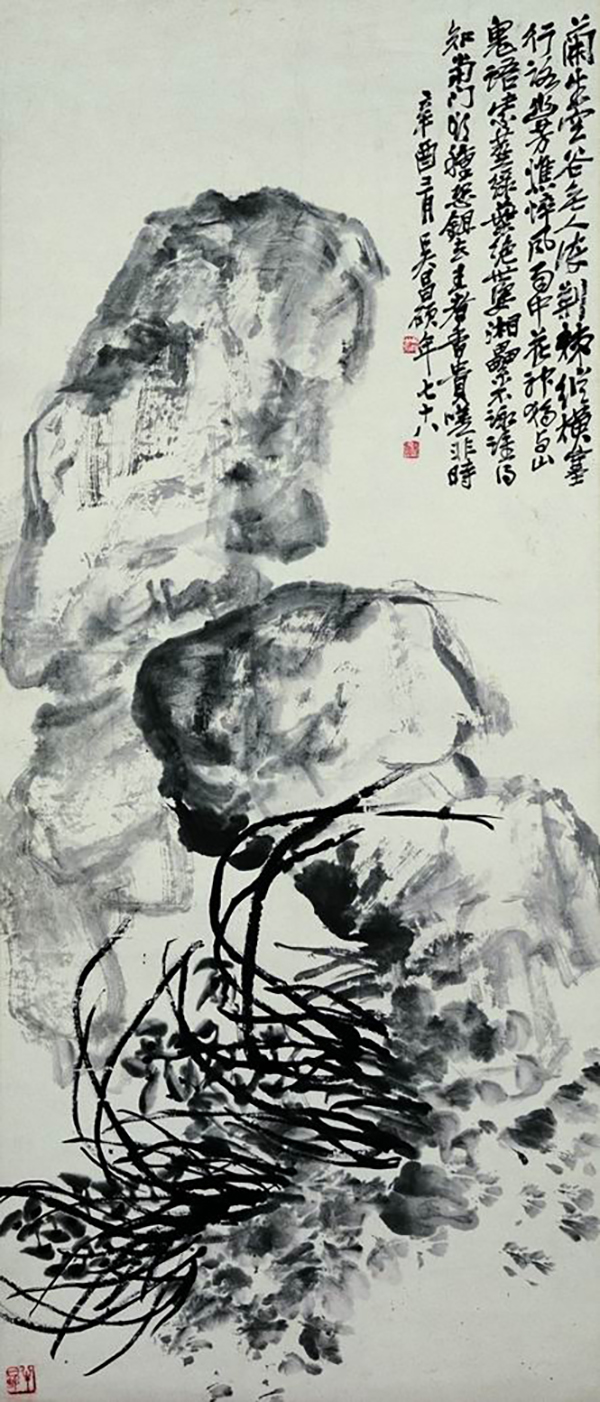
Wu Changshuo, "The Orchid Map of Dieshi" (Axis), 1921, private collection.

The Paper: Wu Changshuo is in an era of cultural transformation between the old and the new. How are the old and new cultures reflected in Wu Changshuo’s life and paintings?

Wu Chao:Wu Changshuo’s "poetry, calligraphy and painting" is mainly the traditional culture of China. Wu Changshuo first learned Zhong You’s lower case calligraphy, and Mr. Pan Tianshou said that Wu Changshuo could still write lower case calligraphy when he was 80 years old. His regular script also contains his "golden stone spirit" The "golden stone spirit" comes from his study of steles. After thousands of years of weathering and time-making, the words carved on stones have been worn away and full of charm. Mr. Wu Changshuo incorporated this flavor into his calligraphy. But he does not exclude foreign cultures. Western red pigments and oil painting techniques have been used in his paintings. We can see that his painting style is as thick and realistic as oil painting. As long as he thinks it is good, he will absorb it both at home and abroad, and continue to learn and improve his art.
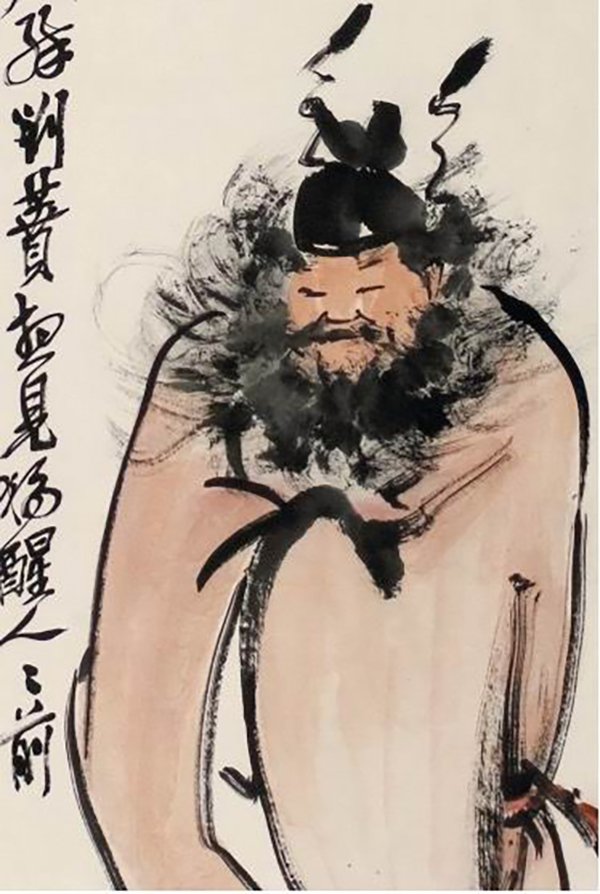
Wu Changshuo, Drunk Zhong Kui Map (Partial), 1921, Zhejiang Provincial Museum.

Wu Changshuo’s account book-pen and ink career

The Paper: Wu Changshuo met Ren Bonian, Wu Dacheng, Wang Yiting and others in Shanghai. What influence did they have on Wu Changshuo?

Wu Chao:At the age of 40, Wu Changshuo met Ren Bonian under the introduction of Gao Zhizhi. Ren Bonian and Wu Changshuo are five years apart, almost equal in age. At that time, Ren Bonian was famous in the painting world, and Wu Changshuo asked him for advice on painting. Before that, Wu Changshuo had begun to learn painting. This time, four plum blossoms painted at the age of 36 were exhibited, which is one of the earliest paintings in Wu Changshuo. At the age of 30, Mr. Wu Changshuo began to learn to draw plum blossoms with his country teacher Pan Zhifu. He loved plum blossoms all his life, and the plum blossoms he painted were elegant and natural. When meeting Ren Bonian, Ren Bonian asked him to draw a few strokes at will by writing. As soon as Wu Changshuo started to write, Ren Bonian told him that if he continued to draw with this brushwork, he would achieve something. So Wu Changshuo has been following the path that Mr. Ren Bonian pointed out for him.
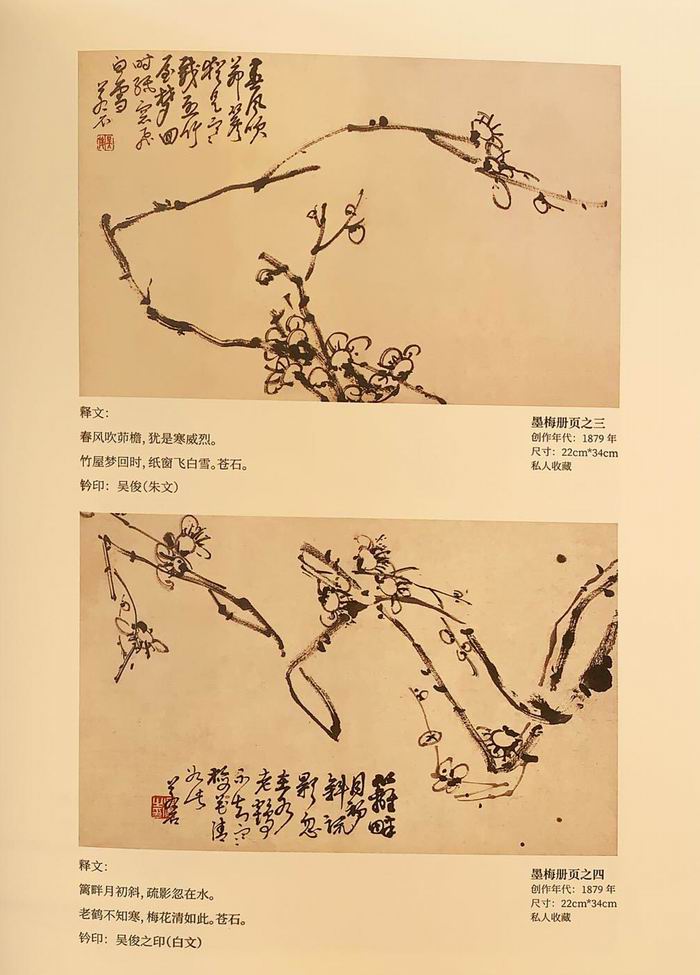
Wu Changshuo, Mo Mei Album III, 1879, private collection.

Mr. Wu Dacheng, an official in the late Qing Dynasty, was also a collector, who helped Wu Changshuo a lot. When Mr. Chang Shuo was in his thirties and forties, he often went to some collectors’ homes to teach. On the one hand, he also arranged cultural relics for his master’s family and learned a lot. There is a work "Deng Mei" in this exhibit, which is inscribed with Wu Dacheng’s seal script. The main idea is to talk with Mr. Wu Changshuo about poetry and painting, which is quite insightful and they have deep feelings. Wu Changshuo also participated in the Sino-Japanese War of 1894-1895 as the staff of Mr. Wu Dacheng, and wrote many indignant patriotic poems. 
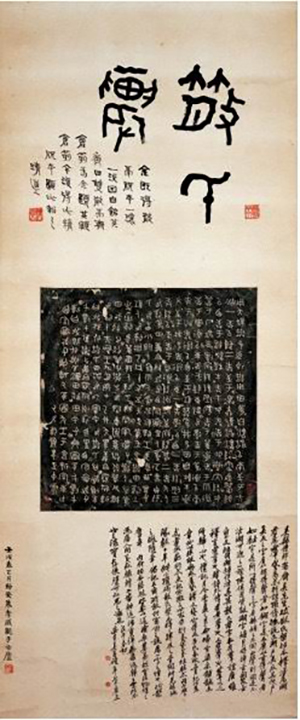
Western Zhou Dynasty’s Sanskrit Inscription (Axis), 1918, private collection.
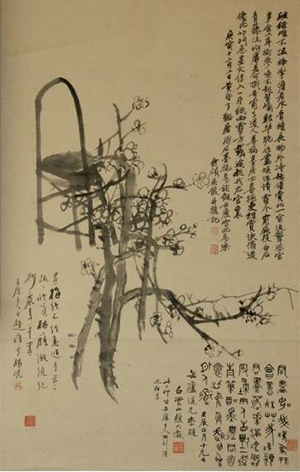
Wu Changshuo, Deng Mei Tu (Axis), 1891, private collection.

Wang Yiting is a teacher and friend to Wu Changshuo. He takes care of Mr. Wu Changshuo wholeheartedly and meticulously, and even helps him arrange some trivial matters in life. In this exhibition, there are several works painted by Chang Shuo and inscribed by Wang Yiting. One of the "Crossing Time and Space" works, "Looking at a Picture of a Man Walking", is very unique. Ren Bonian painted bamboo, Wang Yiting painted people, and Wu Changshuo wrote an inscription. Mr. Ren Bonian painted the bamboo first. Twenty years after his death, his daughter asked Wang Yiting to finish this ink. Mr. Wang Yiting added a portrait of Mr. Chang Shuo enjoying the cool summer night behind the bamboo, with a cattail leaf fan in his hand. The artistic conception of ink painting was quite empty and quiet. After receiving this work, Mr. Chang Shuo was very happy, so he wrote a long title on it to show the friendship between the three people. There is also a flower-and-bird painting, which is also the last ink of Mr. Ren Bonian’s bamboo painting. Twenty years later, Mr. Wang Yiting made up a turtle dove and morning glory, and Wu Changshuo wrote an inscription, which was very clever.
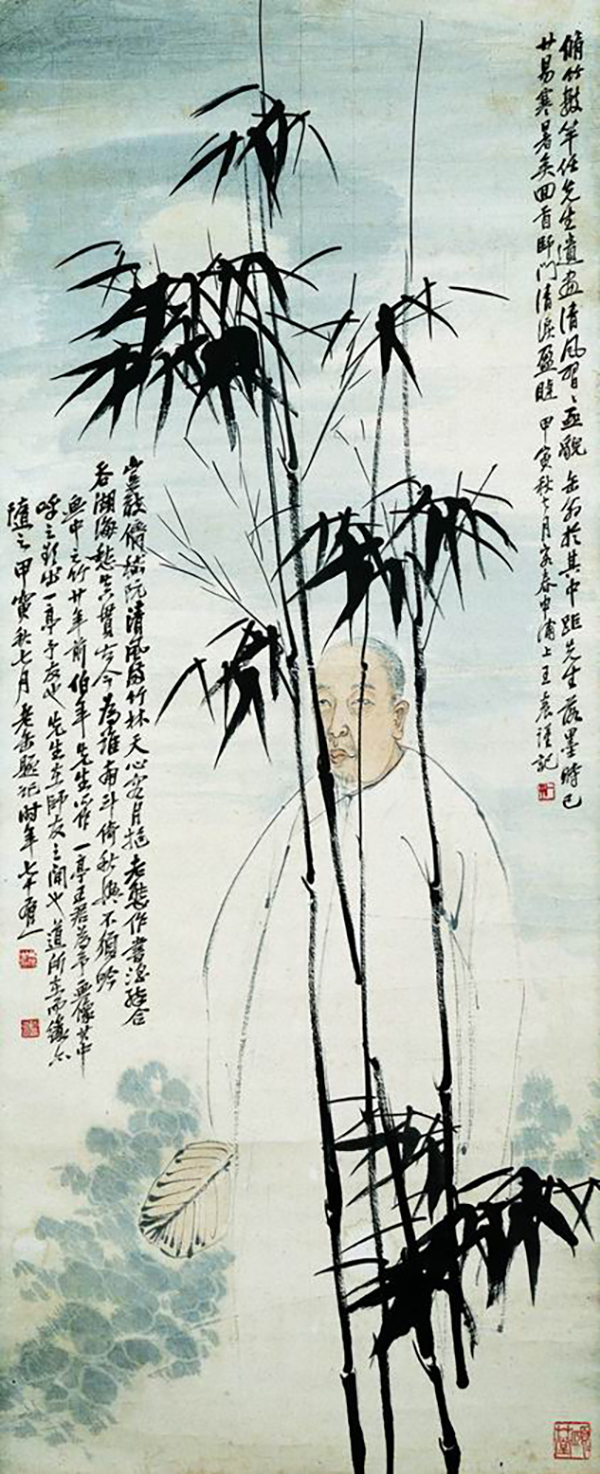
Ren Bonian, Wang Yiting’s Paintings, and Wu Changshuo’s Inscriptions, "A Picture of a Wandering Man" (Axis), 1914, private collection.

The Paper: Wu Changshuo also has contacts with many younger generations. What is his influence on young painters?

Wu Chao:During his stay in Shanghai, Mr. Wu Changshuo also likes to associate with the younger generation and learn new information from them. At that time, the students he coached were Liu Haisu, Pan Tianshou, etc., all in their twenties, and most of them were two generations apart from him. But he never puts on airs because of his qualifications, so young people are willing to come to him to study. 

Wuyue:Mr. Wu Changshuo has a pair of couplets written to Pan Tianshou: "It’s amazing to see the writing, and the gossip always goes into poetry", which contains his requirements for his disciples’ art and manners. At the same time, he also believes that his disciples should not imitate him in their creation, but should form their own style and spirit, and they must have their own personality in art in order to make vibrant and shocking works. The name of the exhibition "Jin Shi Li Cao Mu Xin" also comes from Mr. Wu Changshuo’s couplet "Eating Jin Shi Li Nourishing Cao Mu Xin" given to disciple Wang Geyi. "Cao Mu" refers to the common people, and it is hoped that students will follow the mass line, do not let their works be divorced from life, and take the life content of the common people as the theme of art, which is also the direction of Mr. Chang Shuo’s education.
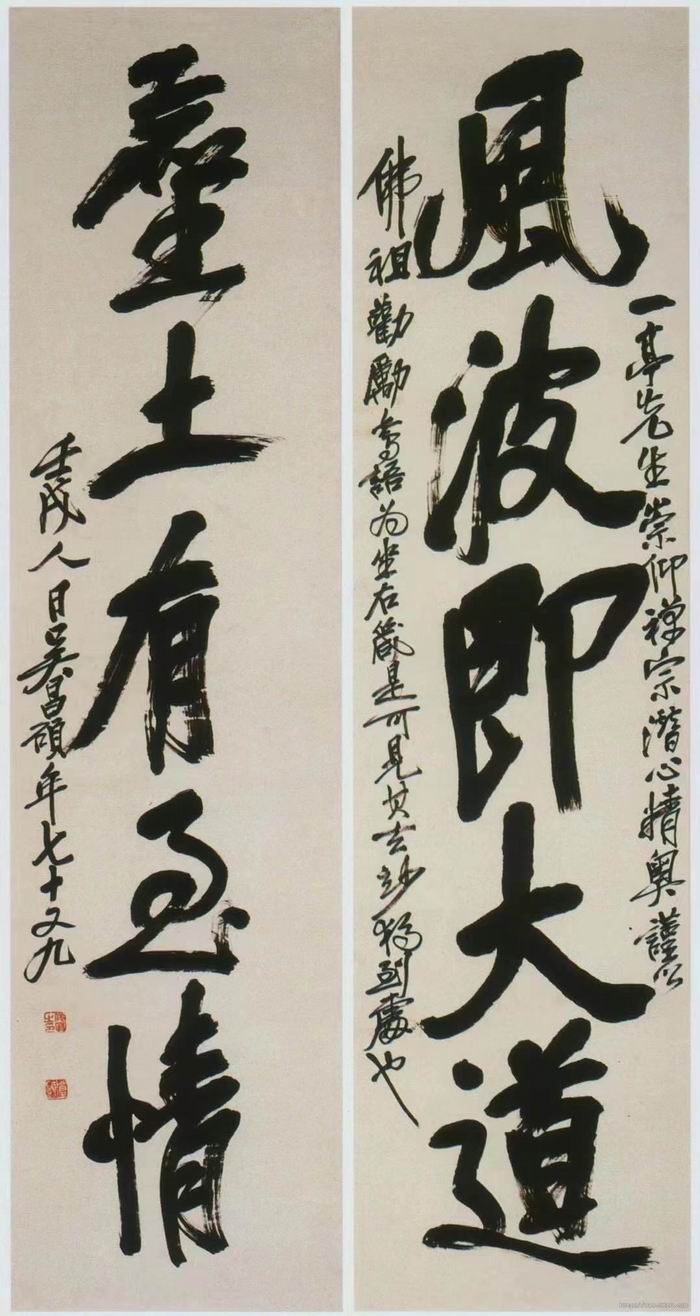
Wu Changshuo, five-character couplet of running script, 1922, collected by Xiling Press.

Wu Changshuo and Painting

The Paper: Pan Tianshou’s "History of Painting in China" said that "Anji Wu Yong Lu Chang Shuo, … learned from the study of stone inscriptions and seals, was a leader of the post-Shanghai school", and how did Pan Tianshou’s "bold and unpretentious, disobedient" reflect in his works?

Wu Chao:Mr. Wu Changshuo is a farmer and knows that hibiscus is a woody plant. However, in "Careless", the hibiscus is a vine. He described the beautiful posture of the imaginary hibiscus, and it seems that the flowers are fluttering on the paper. Under the cursive rattan style, the colors and elements of the flower core are rich and varied. His creation comes from life, but he is not bound by the rules in life. Art comes from life, higher than life, boldly put pen to paper and carefully tidy up.
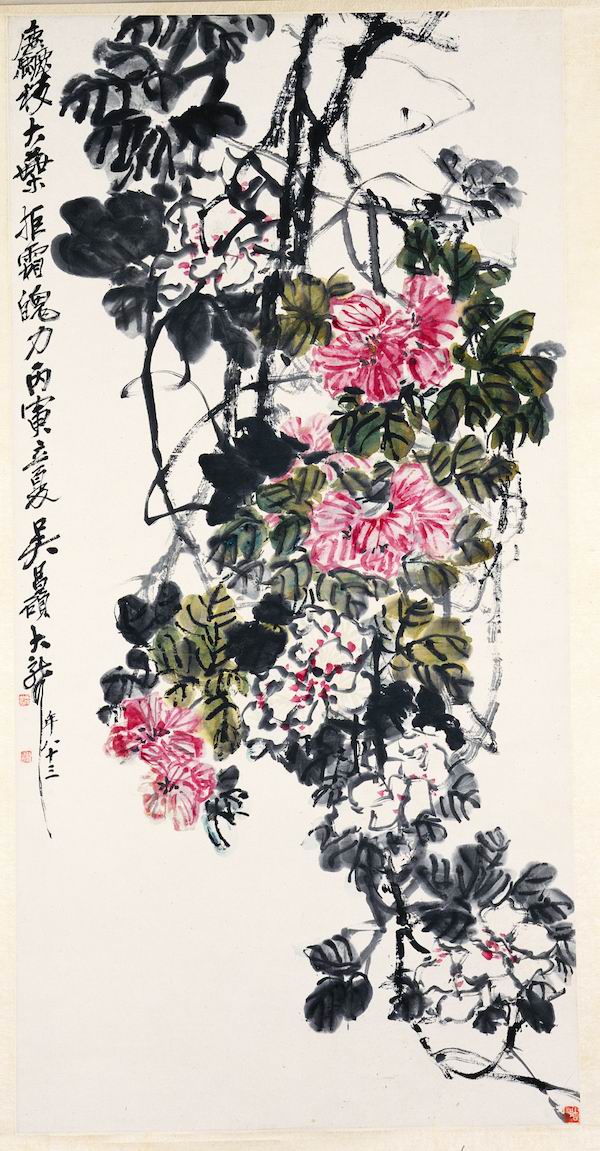
Wu Changshuo, careless (axis), 1926, private collection.

The statue of Dharma is the largest figure painting in Mr. Wu Changshuo’s works, with great momentum. The most wonderful thing in this work is the pen for clothes. Seeing the picture, it seems that you can imagine Mr. Wu Changshuo’s painting appearance in one go.

Wu Changshuo, The Statue of Dharma (Axis), 1910, private collection.

The Paper: "Stone painting style" is the embodiment of Wu Changshuo’s integration of "poetry, calligraphy and printing". How does this connect with the literati painting tradition?

Wu Chao:Before the end of Qing dynasty, the painting was single in color and elegant in color. However, plain colors can’t suppress the lines with strong atmosphere. Wu Changshuo likes to use strong colors of red, big and green to make the painting more energetic. Therefore, Wu Changshuo’s paintings are called freehand brushwork, which brings a fresh atmosphere to the art market. This style usually implies great wealth and great wealth, and it is very popular with some wealthy families. In this exhibition, there is an account book of Mr. Wu Changshuo, which records his daily income, which was very considerable at that time. His "poems, calligraphy and paintings" are all available, and people who come to the door to seek genuine works are in an endless stream, even deeply loved by some Japanese collectors. Compared with the poor living environment of previous painters, the status of Shanghai painters has been improved.

Wu Changshuo, Photo courtesy of the Qing Dynasty, 1891, Shanghai Wu Changshuo Memorial Collection.
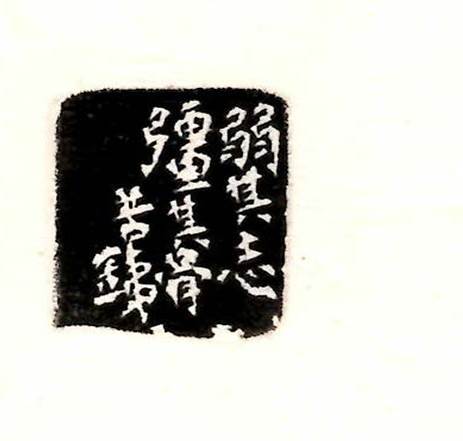
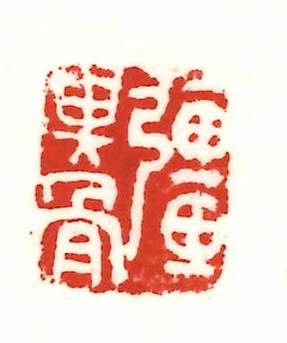
Wu Changshuo, Qiang Qi Gu seal, 1910, 2.1cmx1.8cmx2.4cm, private collection.

Wuyue:Mr. Wu Changshuo earned a considerable income when he was alive. His early years of struggle were quite hard, and he made great progress in his later years, but his life was still simple and rigorous. There is no villa, no mahogany furniture at home, and the husband and wife are respectful. Behind him, all his possessions were basically donated to the society. In 1930, Mr. Wu Changshuo’s son, Wu Dongmai, and friends in the art world initiated the establishment of "Changming Art College" to commemorate Wu Changshuo, which trained many students. Pan Tianshou, Liu Haisu and Wang Geyi all served as teachers in this school. This school was once the activity stronghold of the underground party of the Communist Party of China, which my grandfather Wu Dongmai himself never mentioned. It was only through the memoirs of the underground workers of the party that I learned that he had served communist party in a low-key manner through his special status.

The Paper: Wu Changshuo’s influence on Shanghai painting and culture, and how is Wu Changshuo’s spirit passed down at present?

Wu Chao:Wu Changshuo’s works are always new. In some calligraphy works, we can also see traces of smearing and modification, and we can get a glimpse of his creative process. He has traditional roots in his heart, so his works can be inherited and developed. Looking at Wu Changshuo’s works in his twenties to eighties, we can also see a long and continuous life track with a series of struggles. Wu Changshuo stepped out of everyone’s path step by step. Many painters and painters abandon the foundation in their pursuit of novelty, and their works, even if popular, are only a flash in the pan. Therefore, the so-called innovation is based on the roots. Only by slowly and steadily studying hard in the tradition can we develop our own art.
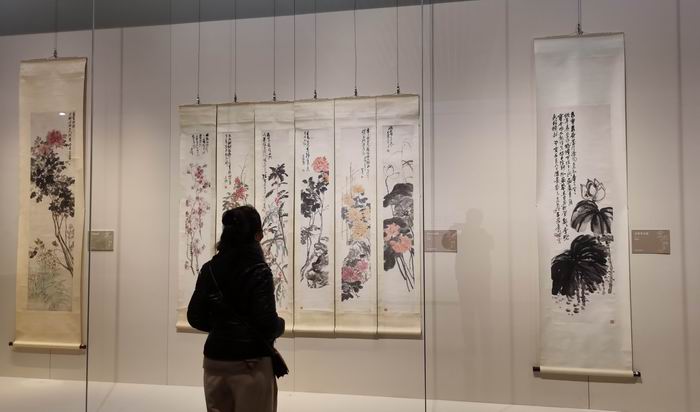
Six screens of flowers at the exhibition site, 1899, Zhejiang Museum.

Wuyue:From Wu Changshuo’s work and study experience, we can learn three spirits. The first is the humanistic spirit, which is the spirit of not being afraid of difficulties and making progress. In this exhibition, you will see that the inkstone used by one party, Mr. Wu Changshuo, is actually just an ordinary brick. Mr. Chang Shuo’s study and living environment in Anji in his early years was difficult. He had no money to buy inkstones, dug out the wall bricks and carved them himself, and one of them was almost worn out. He overcame many difficulties in his artistic path, and finally he succeeded. These inkstones have been passed down to our generation from my father. He said that the inkstones themselves are worthless, but they inherit the spirit of creating conditions without conditions. We put it on display in the exhibition, and also displayed the spirit of the times of the old gentleman who is not afraid of difficulties and dangers, encouraging the younger generation to struggle hard. This spirit will always have the vitality of the Chinese nation. We hope to tell the story of Mr. Wu Changshuo to young people through the exhibition, and tell the correct ideas to overcome difficulties.
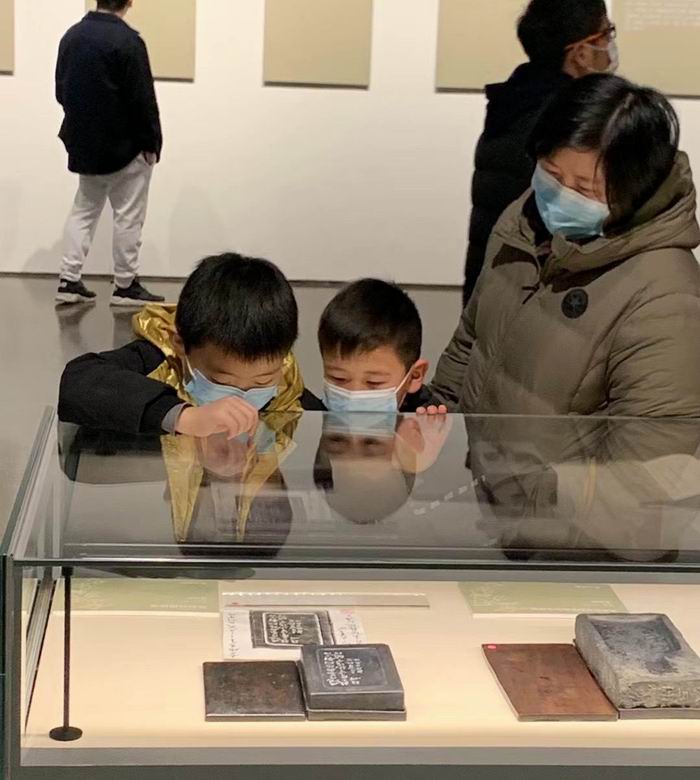
A small audience at the exhibition site is looking at the inkstone carved by Wu Changshuo.
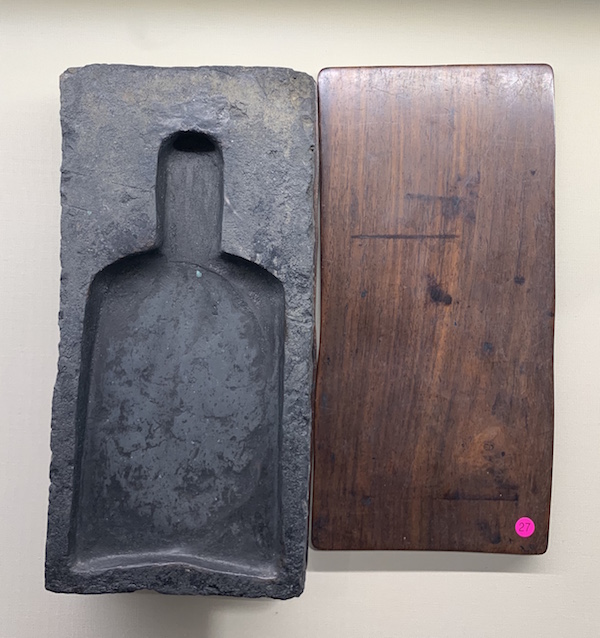
Wu Changshuo carved bricks and inkstones by himself.
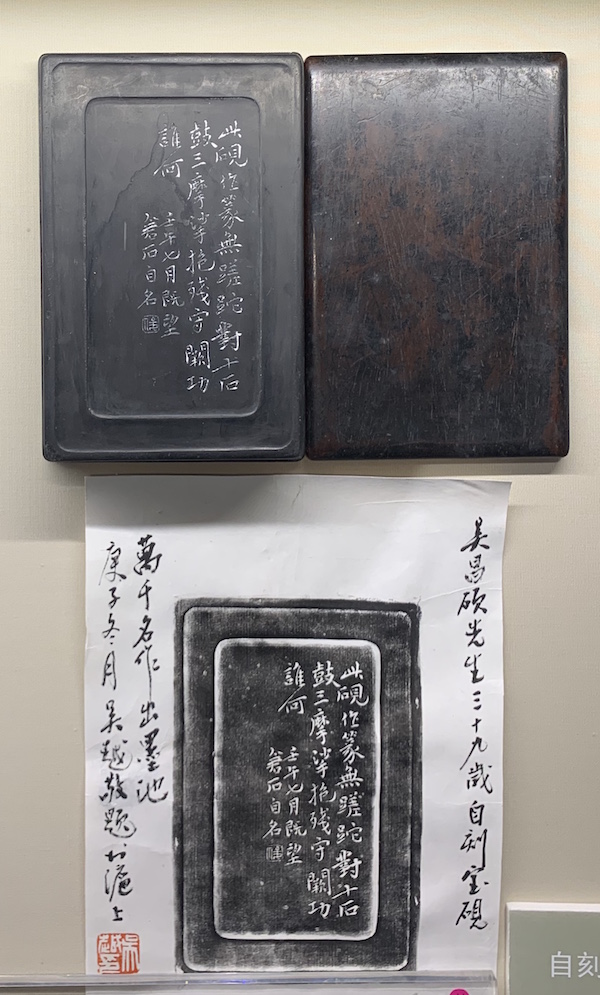
Wu Changshuo carved bricks and inkstones by himself.

Mr. Wu Changshuo also has an indissoluble bond with Pudong, which was a rural area before the development and opening up, but upheld the concept of striving for progress. Nowadays, Pudong is prosperous and has developed a new look of weather. Mr. Chang Shuo also promotes our national spirit through the humanistic spirit in his works of art.

The second is the exploration spirit of "being a disciple with the past and being new with the past", laying a foundation, innovating again and showing a new look of art. The exhibition of China Art Palace is so rich in content, with complete prints of poems, calligraphy and paintings, landscape figures, flowers and animals. Wu Changshuo thought that "the ancients were the guests and I were the mainstay", and on the basis of "being a disciple of the ancients", he achieved "being new with the ancients". Mr. Wu Changshuo likes to create on simple things such as Han bricks and tiles. Everything can be painted in life, and everything can be used for painting, turning antiquities into his own art.

The study room used by Wu Changshuo at the exhibition site.

Wu Changshuo self-use stationery.

The third is the spirit of learning. From his early years, Mr. Wu Changshuo traveled half of China on two legs. At that time, the traffic conditions and communication environment were inconvenient and the situation was unstable. Under such difficult conditions, wherever there are famous teachers, he goes to study, absorbing water like a sponge and turning the advantages of famous teachers into his own things. He traveled all over Huzhou, Hangzhou, Suzhou, Nanjing, Beijing … He learned knowledge with tenacious will. In his later years, he drew motivation from his young friends and lived to learn.
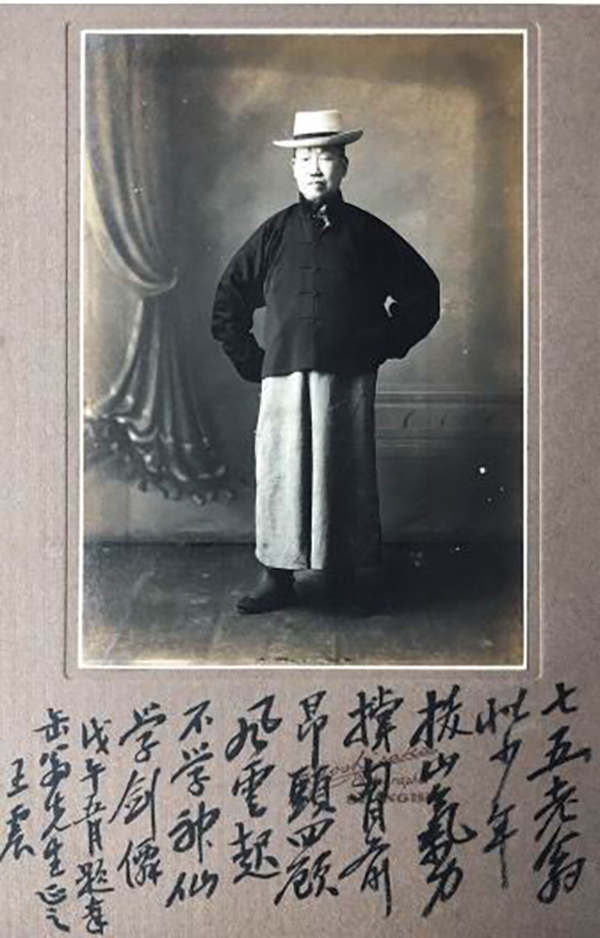
Wu Changshuo, 75.

Wu Changshuo studies.

The Paper: Both China and Japan have studies on Wu Changshuo. Do they have their own emphases?

Wu Chao:Since the reform and opening up in China, the Party and the government have attached great importance to Wu Changshuo’s research and cultural education. Japan’s research on Wu Changshuo has never been interrupted, but most of Wu Changshuo’s works in Japan are created in his later years, and almost none in his early years. Do they want to study Mr. Wu Changshuo’s artistic trajectory systematically and completely, or do they need to rely on China’s materials?
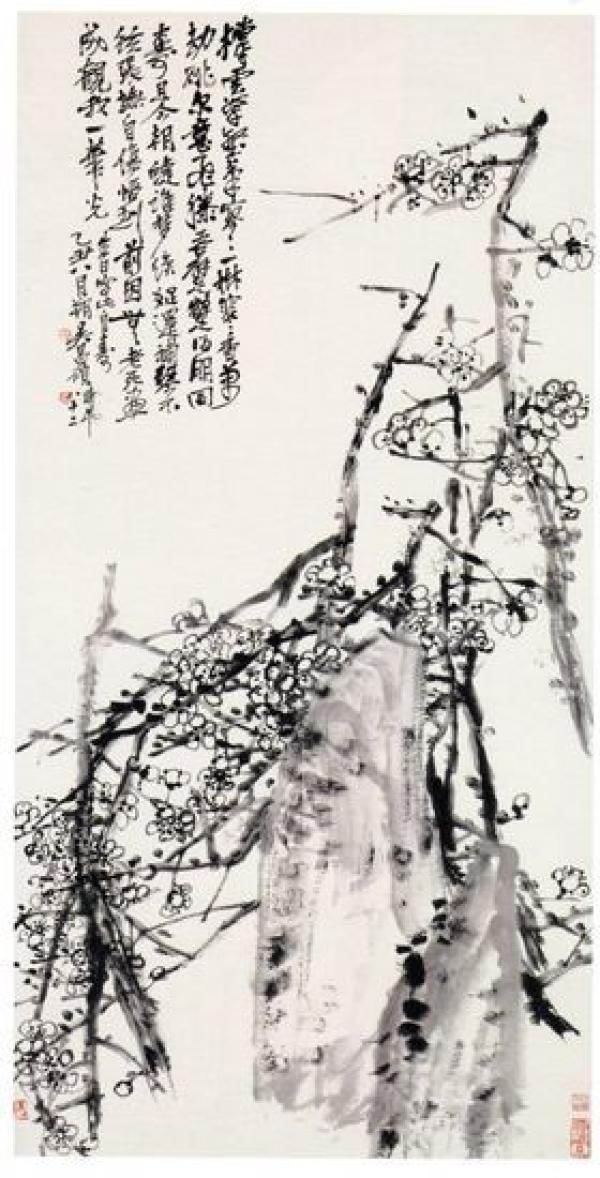
Wu Changshuo’s "Memetu" collected by Tokyo National Museum comes from Qingshan Sugiyama (non-exhibit).

Wuyue:Mr. Wu Changshuo made many Japanese friends and trained a group of Japanese disciples. Through their publicity in Japan, Wu Changshuo’s art entered Japanese textbooks. The proportion of Mr. Wu Changshuo’s works is quite high in Japanese art textbooks from the fourth grade of primary school to graduate students in universities. This is the spread of the excellent traditional culture of our Chinese nation. In 1996, Kyushu also established the Wu Changshuo bust monument. In early 2018, the Tokyo National Museum, Shudao Museum and asakura Sculpture Museum jointly held the exhibition "Wu Changshuo and His Times". Just this year, the Palace Museum in Beijing held a special exhibition of Wu Changshuo’s calligraphy and painting seal cutting in the Palace Museum. In the same year, two national museums in China and Japan held the Wu Changshuo Exhibition, which had great influence. As his descendants, we participated in and supported him all the time.
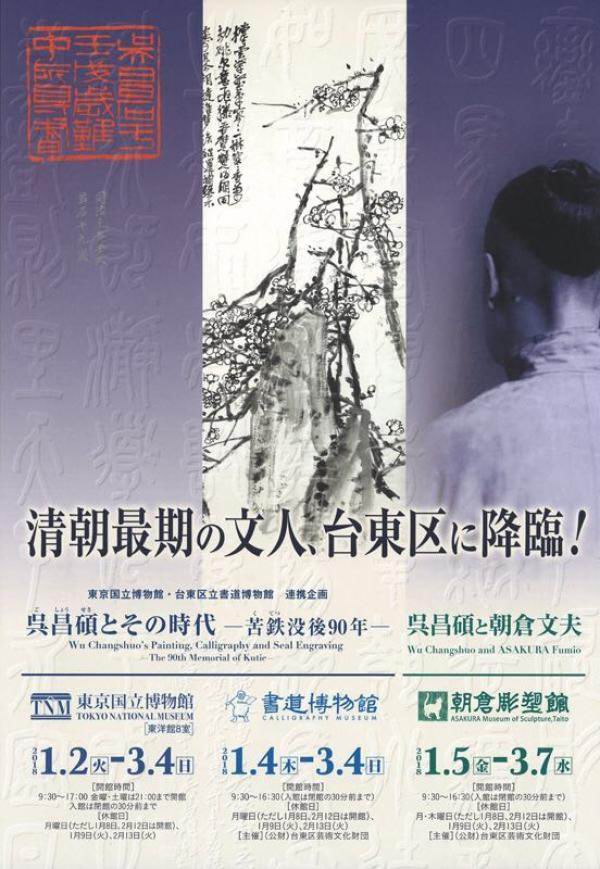
Poster of "Wu Changshuo and His Times" Exhibition in Tokyo, Japan

The Paper: At present, Wu Changshuo has memorial halls in Shanghai and Anji, as well as Wu Changshuo’s former residence in his hometown of Zhen Wu and Shanghai Jiqingli. What is the current preparation for Jiqingli’s former residence? What is the main responsibility of Wu Changshuo Culture and Art Foundation?

Wuyue:Wu Changshuo Memorial Hall in Pudong is a protected building, which is being repaired recently. The renovation of Wu Changshuo’s former residence on Shanxi North Road has also been attached great importance by Jing ‘an District Government, which kept the original house and designed and restored it as the former residence. Recently, the plan has been started, and it is expected to be completed by the 180th anniversary of Wu Changshuo’s birth. There are also plans to build Wu Changshuo Art Museum and Wu Changshuo Cultural Park nearby, which will be a bright spot in the future.
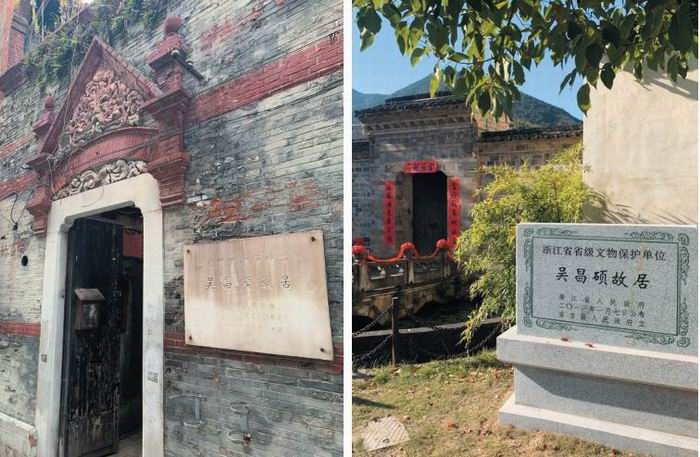
Left: Former residence of Wu Changshuo; Right: Anji Wu Changshuo Former Residence

Wu Changshuo Memorial Hall was established in 1994. This platform has the function of exhibition and introduction, displaying the excellent works of art by Wu Changshuo and his friends, introducing the artistic context of Wu Changshuo, and conducting public education activities through this platform. Wu Changshuo Memorial Hall is a patriotic education base and a free public welfare platform in Pudong New Area. The government requires us to carry forward the spirit of Mr. Wu Changshuo, offer art instruction courses in memorial halls in Pudong New Area, and give lectures in universities, armies and communities to promote culture.
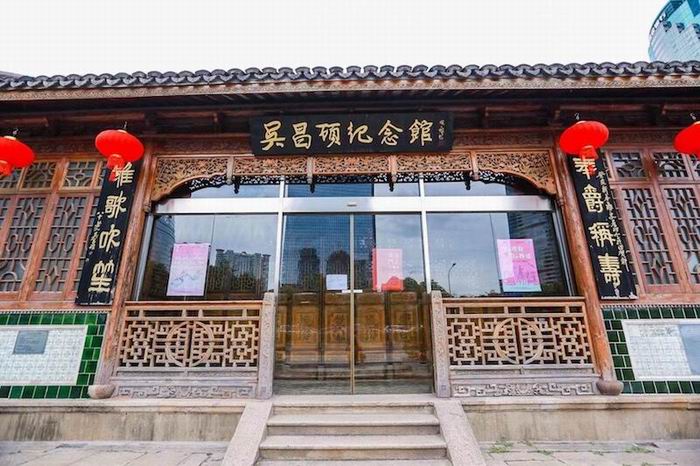
Wu Changshuo Memorial Hall in Lujiazui Central Green Space

Left: Anji Wu Changshuo Memorial Hall; Right: Chaoshan Wu Changshuo Memorial Hall

Wu Changshuo Memorial Hall is also a window for Shanghai’s foreign exchange, and overseas leaders will visit it when they visit China. Former Foreign Minister Yang Jiechi once hoped that our memorial hall would hold an Wu Changshuo exhibition in Japan on behalf of the people. At that time, when the relationship between the two countries was tense, he said that the people must be friendly. Only when Wu Changshuo, which has great influence in Japan, "came out" would the Japanese people see the sincerity of the Japanese people in promoting friendly exchanges between China and.

Wu Changshuo and Wang Yiting are in the Japanese Liusan Park.

Wu Chao:The Foundation mainly collects donated funds from the private sector to finance Wu Changshuo-related activities (including works exhibitions, seminars, etc.). The Foundation was established in 2017 and held many activities. Including former Japanese Prime Minister Yasuo Fukuda and Fuji Murayama, all participated in our activities. We also organized many Shanghai painters and painters to exhibit their works in Singapore and Australia, which is the main responsibility of our foundation.
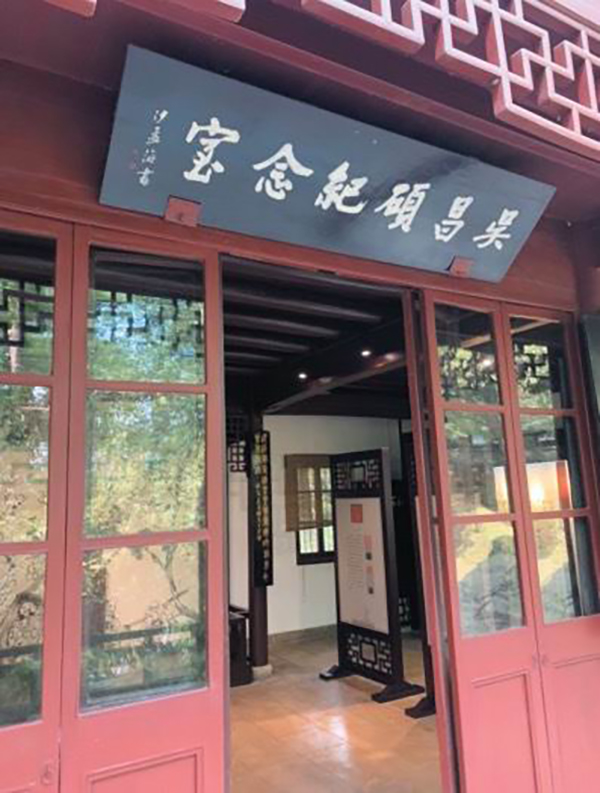
Xi ling yin she Wu Changshuo memorial room

The Paper: As a descendant of Wu Changshuo, what influence did he have on you?

Wu Chao:Mr. Wu Changshuo left us spiritual wealth, one is perseverance, and the other is the innovation that art originates from life and is higher than life. Mr. Wu Changshuo spent his whole life practicing his beliefs, and he also made achievements. He belongs to the Chinese nation and the world. Therefore, as descendants, we didn’t auction our works, but donated his works to the relevant units, so that more people could see Wu Changshuo’s handwriting, and also expanded the perspective of viewing Wu Changshuo from all aspects. Our five brothers and sisters follow the simple life attitude of our great-grandfather. Our responsibility is to carry forward the spirit of Mr. Wu Changshuo, not only at home, but also internationally.
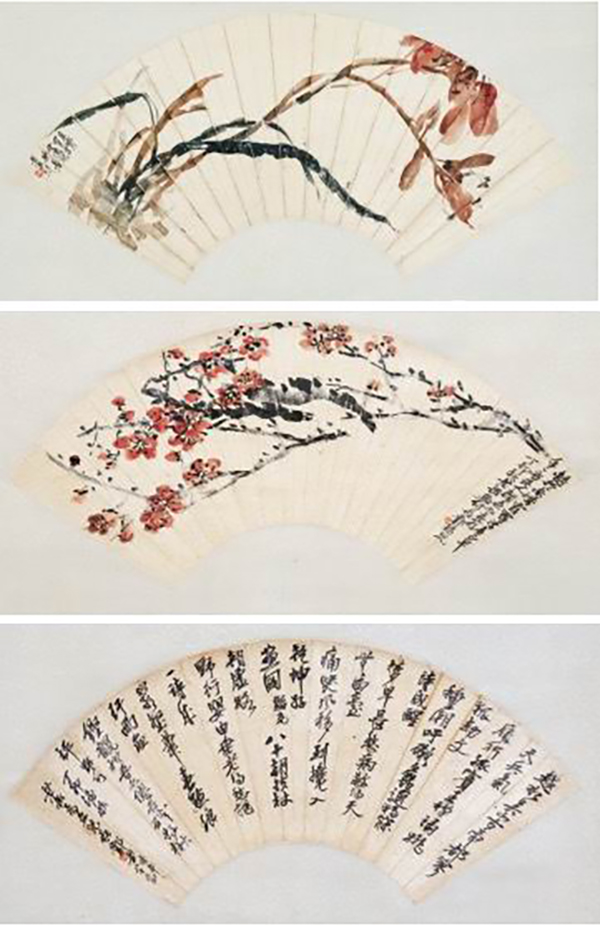
Wu Changshuo painted on the fan of his son Wu Dongmai and his grandson Wu Changye, and kept it in private.

Wuyue:Five of our brothers and sisters will donate their works to the country, giving new vitality to our great-grandfather’s art, which is a consistent tradition of our Wu family. The year before last, we donated another batch of seal cutting to Anji County, the hometown of Wu Changshuo. We educate our descendants, love our ancestors, love art and love our country. The humanistic spirit of this theme has been passed down from generation to generation, and we should carry forward the spirit of Wu Changshuo in our limited life time. How to use our excellent cultural heritage to tell the story of China well? We have changed from a storyteller to a storyteller, and we feel very happy and satisfied.
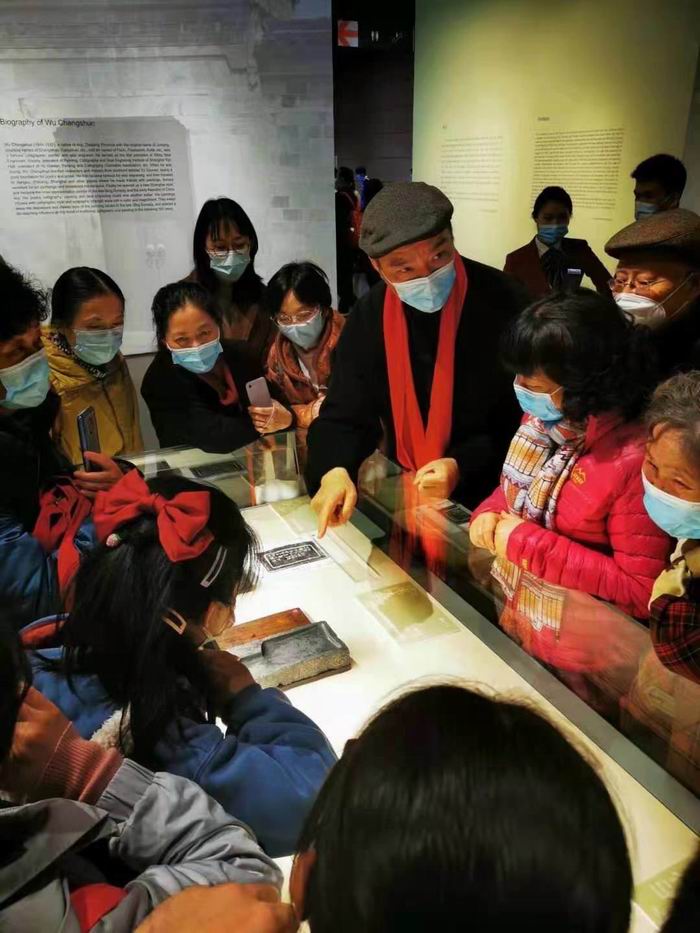
During the Lunar New Year, wuyue toured the Chinese Art Palace.

For this exhibition, we also reorganized the exhibited works and printed the exhibition album, re-interpreted the inscriptions on the works, and converted the uncommon and obsolete words into easy-to-understand sentences, in order to make all the audience read and understand.
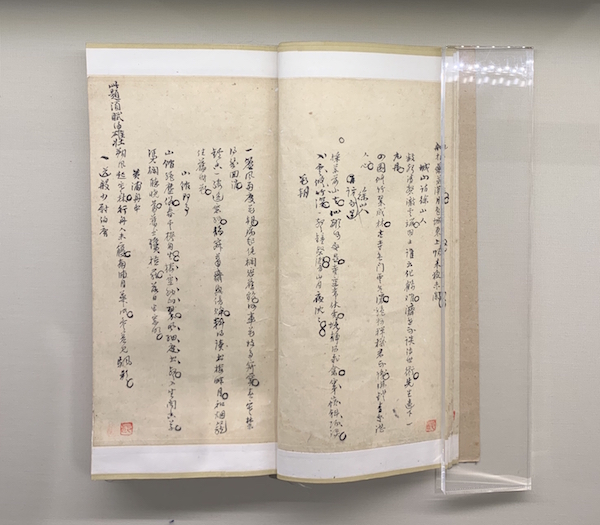
Wu Changshuo’s First Poem Collection —— Early Grass in the Red Papaya Pavilion
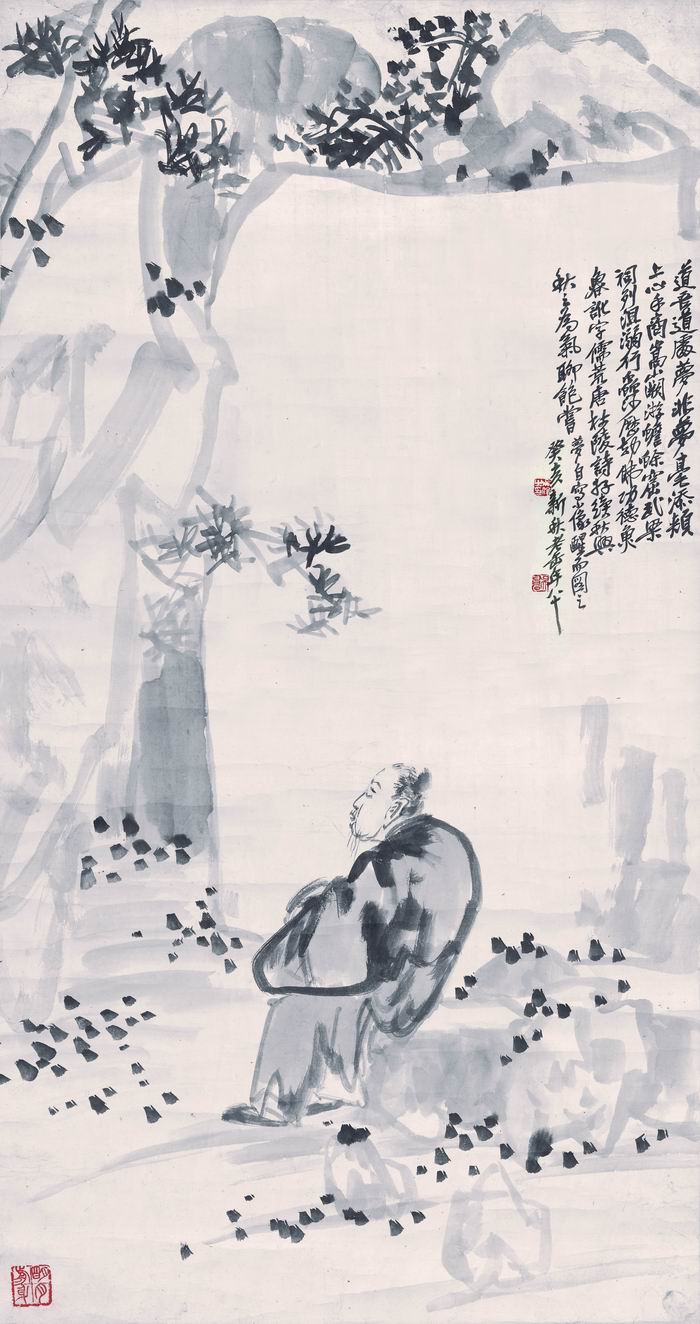
Wu Changshuo, Self-Written Portrait (Axis), 1923, (Anji) Wu Changshuo Memorial Collection.

The exhibition "Jin Shi Li Cao Mu Xin-Wu Changshuo and Shanghai" will be held until May 5th.

Restoring the production order of spring ploughing in different districts and grades: living up to the hope of sowing in spring.

  Recently, various departments all over the country have introduced a number of measures to increase policy support, financial support, scientific and technological support, infrastructure support, etc., and pay close attention to agricultural production in spring to ensure the stable development of agricultural production, providing strong support for winning the epidemic prevention and control war and achieving the goals and tasks of economic and social development this year.

  Liaoning province: save enough agricultural resources to ensure spring ploughing.

  Reporter Zhang Yunqiang reports: Although there is still a period of time before spring ploughing and spring sowing in Liaoning, the agricultural resources market in this province has already prepared the main agricultural resources needed for spring ploughing production. According to the data released by Liaoning Provincial Department of Agriculture and Rural Affairs, at present, the market reserve of main agricultural materials needed for spring ploughing in the province is basically the same as that of the previous year.

  Zhang Guimei, a villager from Xiaoshangang Village, Xingkai Street, kaiyuan city, Tieling, Liaoning, finally put down her hanging heart. After the outbreak of COVID-19, Zhang Guimei has been worried that agricultural materials such as seeds, fertilizers and pesticides will not be available due to the epidemic. Recently, a spring ploughing and preparing agricultural materials fair was held in the village square of Xiaoshangang. Zhang Guimei ordered 20 bags of fertilizer and 12 bags of corn seeds on the spot, so there is no need to worry about farming in the spring.

  According to reports, at present, the estimated demand for spring sowing corn, rice and soybean seeds in Liaoning Province is 80 million kg, 24 million kg and 5 million kg respectively. At present, enterprises in the province reserve about 100 million kilograms of hybrid corn seeds, 29 million kilograms of rice and 6 million kilograms of soybeans, which are sufficient to meet the needs of spring sowing. Liaoning province is also actively protecting the market reserve for the other two major items of agricultural materials, namely, chemical fertilizers and pesticides. At present, more than 90% of large fertilizer enterprises in Liaoning have resumed work, and half of small and medium fertilizer enterprises have resumed work.

  Chongqing:

  Volunteers went deep into the fields.

  Reporter Ran Ruicheng and correspondent Li Yanhua reported that spring ploughing is just around the corner and farming time is urgent. Recently, relying on the New Era Civilization Practice Center, Chongqing organized volunteer service teams to vigorously carry forward Lei Feng’s spirit. While doing a good job in epidemic prevention and control, it extensively carried out Lei Feng’s volunteer service to help farmers cultivate and support agriculture. More than 9,300 volunteer service teams and more than 210,000 volunteers in the city went deep into the fields to help farmers carry out spring ploughing and sowing, technical guidance and distribution of materials.

  Volunteers also do a good job in agricultural technology training by combining online and offline, change centralized training into "peer-to-peer" exchange guidance, and carry out "mobile" technical training by means of WeChat, QQ, SMS, etc., and go deep into the field to help farmers solve practical problems encountered in spring ploughing production. In Hechuan District, more than 200 agricultural technology volunteers conducted more than 50 trainings on planting and breeding for farmers and sent more than 500 agricultural technology information online.

  Actively collect farmers’ material needs, form service orders, organize volunteers and caring motorcades to carry out agricultural purchasing and distribution services for farmers, establish a "mobile agricultural supermarket", and deliver seeds, fertilizers and other materials to farmers’ doorsteps. Bishan District has established an agricultural distribution service team to purchase and distribute more than 2,600 tons of chemical fertilizer and more than 6,000 packages of seeds for more than 10,000 villagers.

  They also use e-commerce platforms, webcasts, WeChat and other means to recommend fruits, vegetables, poultry and other products, conduct online procurement, and contact merchants and units to purchase at home to help solve the problem of difficult sales of agricultural products.

  Jinshan District, Shanghai:

  Fruit and vegetable production in suburbs is busy

  Our reporter Li Zhiguo and correspondent Ge Xiaoli reported that on the one hand, the spring ploughing season is busy, and on the other hand, the epidemic prevention and control is carried out in an orderly manner. In the past few days, Jinshan District, Shanghai, under the premise of doing a good job in epidemic prevention, has started the spring ploughing mode in an orderly manner.

  Wang Weiguo, the head of Tianmu Orchard in Langxia Town, Jinshan District, told the reporter: "This year’s work is more masks, gloves and thermometers. Punching cards every day is the foundation. Then, according to the planting process, step by step, I believe that this year’s peaches will definitely not let everyone down."

  The small crown watermelon in Langxia Town is also being bred. "The 200-acre small crown is planted, and you can eat watermelon at the end of April." Zheng Jinyong, head of Shanghai Dexin Fruit and Vegetable Professional Cooperative, said that due to the epidemic, some foreign workers did not come back from their hometown, so he organized a group of local workers to start planting early, and the progress of planting melons was not greatly affected.

  Fruit and vegetable planting in Fengjing Town, Jinshan District is also proceeding in an orderly way. Sun Xianfu of Xinxin Village in Fengjing Town did not return to his hometown for the New Year, and the pace of resuming field production was not affected by the epidemic. Now his 100-mu watermelon has entered the seedling stage in the greenhouse. Shen Jianying of Xingta Village in Fengjing Town also planted 50 mu of melons, watermelons and cantaloupes this year. According to statistics, at present, there are 110 breeding cooperatives in Fengjing town, and the rate of returning to work has reached 100%.

  Bayi District, Linzhi City, Xizang:

  Strive to create a "hometown of strawberries"

  Reporter He Jianming and correspondent Yang Zhihong reported that Gengzhang Township, Bayi District, Linzhi City, Xizang, has made great efforts to build the brand of "Hometown of Strawberries" according to the actual situation of the township and the idea of "one town, one product", and the township government has led the establishment of a professional cooperative for farmers and herdsmen of Yajue strawberry planting in Bayi District, Linzhi City. At present, the cooperative has built a strawberry base with an area of 25 mu and 10 modern greenhouses. At the end of last year, the township government organized the masses to plant 145,000 red strawberries, which are now growing well. The total output is expected to reach 75,000 Jin this year.

  Recently, people wearing masks were working in the strawberry planting base in Menzhong Village, Gengzhang Township, Bayi District, Linzhi City, Xizang. Gamaxi, secretary of the Party branch of Menzhong Village, took the temperature of everyone who came to work with an electronic temperature gun and registered it. Gamasi Rao said that although the epidemic situation in COVID-19 is not over yet, strawberries in the fields wait for no one. While doing a good job in epidemic prevention and control, the masses have been working in the base in batches and orderly.

  "Now is the flowering period of strawberries, and it is also an important stage of strawberry growth, which is directly related to this year’s harvest. Resident team and village ‘ Two committees ’ We formulated a plan to resume agricultural production during the epidemic prevention and control period, actively organized the masses to grasp production, and ensured that the epidemic prevention and control and agricultural production were correct. " Hu Meng, captain of the resident team, said.

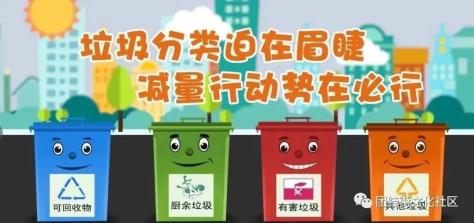
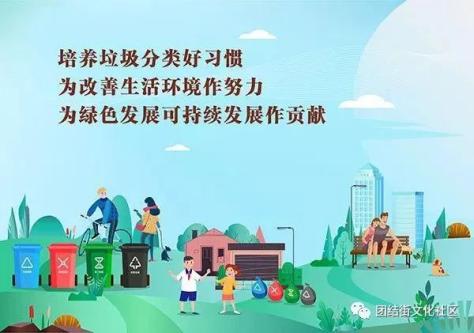
Waste sorting is imminent, and reduction action is imperative.

garbage classification

01

——

What is garbage sorting?

Garbage classification is to classify garbage according to recyclable and non-recyclable methods.

Human beings will produce a lot of garbage every day, and a lot of garbage will be recycled without classification and discarded at will, which will cause environmental pollution. Garbage classification is to put garbage into the source by classification, and make it become a resource again through sorting, clearing and recycling.

02

——

What are the benefits of garbage sorting?

1. Reduce land erosion

Some substances in domestic garbage are not easy to degrade, which makes the land seriously eroded. Garbage sorting, removing recyclable and non-degradable substances, reducing the amount of garbage by more than 60%.

Step 2 reduce pollution

Garbage disposal in China mostly adopts sanitary landfill or even simple landfill, occupying tens of thousands of acres of land; Insects and flies fly around, sewage overflows and stinks, which seriously pollutes the environment.

Waste plastics in soil will lead to crop yield reduction, and abandoned waste plastics are eaten by animals by mistake, resulting in accidents of animal death from time to time. Because it can also reduce the harm than recycling.

03

——

What does harmful waste include?

Harmful waste includes: waste batteries, waste fluorescent tubes, waste water silver thermometers, expired drugs and other wastes that need special safety treatment.

Other wastes include: tiles, ceramics, slag, and wastes that are difficult to recycle. Sanitary landfill can effectively reduce the pollution of groundwater, surface water, soil and air.

04

——

Advantages of garbage sorting

Most of the garbage disposal methods are in the traditional way of stacking and landfill, occupying tens of thousands of acres of land; And mosquitoes and flies fly around, sewage overflows and stinks, which seriously pollutes the environment. Therefore, classified collection of garbage can reduce the amount and equipment of garbage treatment, reduce the treatment cost and reduce the consumption of land resources, which has social, economic and ecological benefits.

The advantages of garbage sorting treatment are as follows:

1. Reduce land occupation: Some substances in domestic garbage are not easy to degrade, so that the land is seriously eroded. Garbage classification, removing recyclable and non-degradable substances, reducing the amount of garbage by more than 60%.

2, reduce environmental pollution: waste batteries contain toxic substances such as metal mercury and nylon, which will cause serious harm to human beings; Waste plastics in soil will lead to crop yield reduction, and abandoned waste plastics are eaten by animals by mistake, resulting in accidents of animal death from time to time. Therefore, recycling can reduce harm.

3. Turning waste into treasure: China uses 4 billion plastic fast food boxes, 500-700 million instant noodle bowls and billions of disposable chopsticks every year, which account for 8-15% of domestic garbage. One ton of waste plastic can recycle 600 kilograms of diesel oil. Recycling 1,500 tons of waste paper can avoid cutting down trees used to produce 1,200 tons of paper. 30%-40% of the production waste can be recycled, so we should cherish this small-scale and large-scale resource.

05

——

Significance of garbage classification

1. Separate kitchen garbage with perishable organic components to provide high-quality raw materials for garbage composting and produce high-quality organic fertilizer, which is conducive to improving soil fertility and reducing fertilizer application.

2. The kitchen garbage with high moisture content is separated, which improves the incineration calorific value of other garbage and reduces the difficulty of secondary pollution control in garbage incineration. The content of pathogenic bacteria is beneficial to the harmless treatment of garbage, which reduces the risk of water, soil and air pollution in garbage treatment, classifies harmful waste, and reduces heavy metals and organic pollutants in garbage.

3. Classifying harmful waste reduces the contents of heavy metals, organic pollutants and pathogenic bacteria in garbage, which is beneficial to the harmless treatment of garbage and reduces the risk of water, soil and air pollution in garbage treatment.

4. Different kinds of garbage are diverted, which greatly reduces the amount that eventually enters the sanitary landfill and prolongs the service life of the landfill.

5. Improve the recycling ratio of waste products, reduce the demand for raw materials and reduce the emission of carbon dioxide.

Original title: "Waste classification is imminent and reduction action is imperative"

Read the original text

Which trucks need to apply for electronic access codes? There will be a major change in the passage of trucks in Chengdu, and the authoritative answer has come.

On June 1, Chengdu Public Security Bureau, Chengdu Ecological Environment Bureau, Chengdu Transportation Bureau, Chengdu Urban Management Committee and Chengdu Housing and Urban-Rural Development Bureau jointly issued a notice on traffic management measures for some trucks.From June 10, 2021, new management measures will be implemented for truck traffic.
Which trucks need to apply for electronic access codes? What is the difference between the time and scope of the ban? On June 2nd, the Traffic Management Bureau of Chengdu Public Security Bureau answered questions of public concern.
Question 1: Can all trucks that meet the exhaust emission standards apply for the Chengdu Electronic Pass Code for Freight Cars?
Answer:Incorrect understanding. Meeting the exhaust emission standards is only a prerequisite for applying for a pass code. At present, in principle, only "Chuan A" fuel gas trucks that cannot be replaced by new energy vehicles can apply for electronic access codes, and they must be transported during the day. After consultation with relevant departments, it is clearly stipulated that the following six categories of trucks can apply for the pass code. Other ordinary freight vehicles cannot apply for a pass code in principle, and can be transported at night or by new energy trucks. The seventh case is mainly aimed at the individual cases where the six categories of needs are not covered, but there are indeed needs.
(1) For concrete trucks and ready-mixed mortar trucks, the demand confirmation department is Chengdu Housing and Urban-Rural Development Bureau.
(2) Cold-chain transport vehicles, and the demand confirmation department is Chengdu Transportation Bureau.
(3) Three-green engineering vehicles, and the demand confirmation department is Chengdu Municipal Bureau of Commerce.
(4) Landscaping vehicles, and the demand confirmation department is Chengdu Park Urban Construction Administration.
(5) For municipal law enforcement and operation vehicles, the demand confirmation department is Chengdu Urban Management Committee.
(6) Domestic waste transport vehicles (vehicles with a total mass of less than 12 tons must be registered on or before August 4, 2020), and the demand confirmation department is Chengdu Urban Management Committee.
(seven) the approved load quality of other fuel and gas trucks jointly recognized by various departments and the letter department shall be within 5 tons (inclusive).The demand confirmation department is Chengdu Economic and Information Bureau. For example, schools need to apply to the Education Bureau; The hospital needs to apply to the health department; If there is demand for urban distribution, apply to the Transportation Bureau. It is jointly recognized by the department and the letter department. The applications submitted by various demand units must be irreplaceable by new energy trucks, and must be transported by oil and gas trucks, and the transportation time must also be transported during the daytime.
Question 2: What are the conditions for applying for the Chengdu Freight Car Electronic Pass Code?
Answer:Motor vehicle owners, the trucks they apply for should meet the following conditions at the same time: (1) Sichuan A-registered trucks. (two) the vehicle must be within the validity period of the inspection when applying. (3) The vehicle has no unprocessed traffic violation record. (4) Exhaust emission requirements: 1. Vehicles applying for full-time pass codes must meet the national emission standards of V and above. 2. Vehicles applying for the pass code during the peak hours: they must meet the national emission standards of stage IV and above. 3. Domestic waste transport vehicles applying for full-time pass codes and flat-peak pass codes must meet the national emission standards of V and above.
Question 3: Where is the use area of Chengdu Freight Car Electronic Pass Code?
Answer:(1) The area around the city of High-tech South Zone [Chengdu Ring Expressway (G4202, inclusive), Jiannan Avenue (inclusive), Tianfu Fifth Street (inclusive), the middle section of Tianfu Avenue (inclusive), Tianhua Second Road (inclusive), Century City South Road (inclusive), Century City Road (inclusive), Century City East Road (inclusive) and Kehua South Road (inclusive)All roads within. (2) The area within Chengdu Ring Expressway (G4202, inclusive).
If you don’t need to pass in the above areas or within the time limit, you don’t need to apply for a pass code. Ruchuan A-class trucks pass between the Third Ring Road and the Ring Expressway during peak hours.
Question 4: What are the types of Chengdu Freight Car Electronic Pass Code?
Answer:(1) Full-time pass code: it is allowed to pass all day in the area around the city of High-tech South Zone and the area within the Chengdu Ring Expressway (G4202, inclusive).
(2) Pass code during peak hours: except for the morning and evening peak hours (7:00 to 9:00, 17:00 to 19:30), it is allowed to pass in the area around the city of Gaoxin South District and within the area around Chengdu Expressway (G4202, inclusive).
Question 5: How long is the validity period of Chengdu Freight Car Electronic Pass Code?
Answer:The validity period of Chengdu Freight Car Electronic Pass Code is from the effective date of the electronic pass code to May 31, 2022.
Question 6: What are the application procedures for Chengdu Freight Car Electronic Pass Code?
Answer:(1) If the owner of a motor vehicle submits a demand to the demand confirmation department, such as a cement tanker, he shall submit an application to the housing construction department. Special reminder, the majority of car owners should not apply across industries. Industry classification is clearly defined in question 1. The demand confirmation department shall verify and confirm in accordance with these Measures, and the verified ones shall be entered into the "Rong E Line" platform and transferred to the Traffic Management Bureau of Chengdu Public Security Bureau for further processing; If the verification fails, the demand confirmation department shall inform the applicant.
(2) The Traffic Management Bureau of Chengdu Public Security Bureau shall verify and confirm in accordance with these Measures, and verify the issuance of "Chengdu Truck Electronic Pass Code"; If the verification fails, the Traffic Management Bureau of Chengdu Public Security Bureau will inform the applicant.
Question 7: What is the management mechanism of Chengdu Freight Car Electronic Pass Code?
Answer:(1) If a truck that has obtained the Electronic Pass Code for Freight Cars in Chengdu fails to pass the exhaust emission test under the supervision of the ecological environment department, the electronic pass code of the truck shall be revoked. After the re-inspection of maintenance is qualified, apply again according to the procedure. Since the first acquisition of the "Chengdu Freight Car Electronic Pass Code", if it fails to pass the supervision and sampling test for 2 times within this year, it shall not re-apply within one year from the date of revocation. (2) The electronic pass code of a truck that has obtained the Chengdu Electronic Pass Code shall be revoked under any of the following circumstances; Within one year from the date of revocation, no new application may be made:
1. Failing to engage in the transportation of goods according to the application purpose;
2. Driving away after a traffic accident;
3. There are 5 or more traffic violations that have not been dealt with, and they have not been dealt with within 30 days; Special reminder, please deal with traffic violations in time, and the number of unprocessed violations must not exceed 5.
4. Illegal loading of hazardous chemicals;
5. Drunk driving, drunk driving and drug driving are illegal.
Question 8: Is there a transition period for trucks with national emission standards III and below to be banned in Chengdu Ring Expressway?
Answer:In order to facilitate car owners to change vehicles, on the basis of widely listening to the opinions of the masses, it is decided to adjust the implementation time of this measure to September 1, 2021. According to the relevant regulations, starting from July 1, 2013, new car registration began to implement national IV and above standards.
Question 9: What is the time and scope of the ban on foreign trucks?
Answer:From 7:00 to 21:00 every day, it is forbidden to go within the Chengdu Ring Expressway (G4202, excluding) and the area around the city in the High-tech South Zone.South of Chengdu Ring Expressway (G4202, excluding), Jiannan Avenue (including), Tianfu Fifth Street (including), middle section of Tianfu Avenue (including), Tianhua Second Road (including), Century City South Road (including), Century City Road (including), Century City East Road (including) and Kehua South Road (including).All roads in the road.
Special reminder: trucks with yellow license plates are not allowed to enter Chengdu Ring Expressway every day (7:00-09:00 and 17:00-19:30).
Question 10: What is the forbidden time and scope of trucks with large number plates?
Answer:From 7: 00 to 9: 00 and from 17: 00 to 19: 30 every day, it is forbidden to drive into Chengdu Ring Expressway (G4202) through toll stations and interchanges. There is no restriction on the passage of blue brand trucks on Chengdu Ring Expressway (G4202). However, it should be noted that you can’t drive into the ring expressway and the high-tech south zone within the above time period.
Please pay attention to the majority of car owners and drivers. First, plan ahead and stagger the morning and evening peaks; Second, leave the radial expressway in advance, and don’t wait at the toll station or the expressway; Third, trucks that have entered Chengdu Ring Expressway (G4202) through toll stations and interchanges before the no-go period can continue driving on Chengdu Ring Expressway (G4202). However, it should be noted that Sichuan A-registered trucks cannot enter the expressway around the city and the high-tech south zone within the above-mentioned time period. Foreign trucks can’t drive into the area around the city and the High-tech South Zone from 7: 00 to 21: 00.
Question 11: What is the time and scope of the ban on Sichuan A trucks?
Answer:(1) It is forbidden to drive on the regional roads between the Third Ring Road (inclusive) and Chengdu Ring Expressway (G4202, exclusive) from 7:00 to 9:00 and from 17:00 to 19: 30 every day.
(2) From 7:00 to 21:00 every day, it is forbidden to be in the Third Ring Road (excluding) and the High-tech South Zone [Third Ring Road (excluding), Jiannan Avenue (including), Tianfu Fifth Street (including), Tianfu Avenue Middle Section (including), Tianhua Second Road (including), Century City South Road (including), Century City Road (including), and Century City.All roads in the road.
Question 12: What are the vehicles that are not restricted by the restriction policy?
Answer:(a) hanging new energy vehicle number plate truck. Special reminder: New energy trucks that have not replaced the new energy vehicle number plate, please take the time to replace them, and they will still be restricted before they are replaced.
(two) military vehicles, police cars, fire engines, ambulances, engineering rescue vehicles and special vehicles for China Post.
Red Star Journalist Zhang Zhaoting
Editor Yu Mange
(Download Red Star News, and get a prize! )
Reporting/feedback

She is the adopted daughter of the former Prime Minister, a 55-year-old female official who entered the inner circle of Kim Jong-un.

On April 12, the first meeting of the 14th Supreme People’s Assembly of the DPRK closed in Pyongyang. At this meeting, Kim Jong-un, the top leader of North Korea, was re-elected as the chairman of the State Council. Cui Longhai succeeded Jin Yongnan as the chairman of the Standing Committee of the Supreme People’s Assembly, and Cui Longhai was also appointed as the first vice chairman of the State Council.

In addition, Park Fengzhu was elected as the vice chairman of the State Council; Jin Cailong, Li Wanjian, Li Zhuyong, Yeong-cheol Kim, Taizong Xiu, Li Yonghao, Su gil Kim, Nu Guangtie, Zheng Jingxuan, Cui Fuyi and Cui Shanji were elected as members. As a result, a new leadership team headed by Kim Jong-un was formed in North Korean politics. Jin Cailong succeeded Park Fengzhu as the Prime Minister of the Cabinet, and unanimously adopted the list of cabinet members proposed by Jin Cailong.

Cui Shanji (first row, left)

Cui Shanji (first row, left)

The list of the new DPRK Council of State includes Yeong-cheol Kim, vice chairman of the Labor Party Central Committee in charge of DPRK’s negotiations with the United States, Li Yonghao, foreign minister, and Cui Shanji, former vice foreign minister. Among them, Cui Shanji is the first State Councilor, and she is also the only woman in the new DPRK State Councilor.

According to a photo report published in Rodong Sinmun, the official newspaper of the Workers’ Party of Korea, Cui Shanji has been promoted to be the first deputy minister of the Ministry of Foreign Affairs to replace Kim Kye Gwan. Yonhap News Agency and other media explained that as an "American expert" in North Korea, Cui Shanji has always stood in the front line in two DPRK-US summit meetings, and her promotion shows that North Korea attaches importance to its diplomacy with the United States; She will play a greater role in the follow-up dialogue between the DPRK and the United States.

Cui Shanji data map

Cui Shanji (network map)

According to Korean media reports, Cui Shanji was born in 1964 and is the adopted daughter of former North Korean Prime Minister Cui Yonglin. According to Korea Economy, Cui Shanji has received excellent education since childhood. She has studied in Austria, Malta and China, and is proficient in English and familiar with the western world.

Since 1980s, Cui Shanji has worked in the DPRK Foreign Ministry as a researcher and interpreter. His face is well known overseas because from 2003 to 2008, Cui Shanji was the chief translator of the DPRK in the six-party talks on the DPRK nuclear issue. In August 2009, when former US President Bill Clinton visited Pyongyang, Cui Shanxi worked as a translator. In 2010, Cui Shanji was promoted to deputy director of the North American Bureau of the DPRK Foreign Ministry, and attended the denuclearization talks held in Bali in July the following year as the deputy representative of the DPRK. In 2016, she became the director of the North American Bureau of the Ministry of Foreign Affairs and won the trust of Kim Jong-un, the top leader of North Korea.

DPRK Foreign Minister Li Yonghao (right) and Vice Foreign Minister Cui Shanji (left)

DPRK Foreign Minister Li Yonghao (right) and Vice Foreign Minister Cui Shanji (left)

It is reported that Cui Shanji has an extraordinary relationship with members of the Political Bureau of the Communist Party of China Central Committee, the current Workers’ Party of Korea, member of the DPRK State Council and DPRK Foreign Minister Li Yonghao. Li Yonghao’s father, Li Mingji, was Kim Jong Il’s big housekeeper and served as the organization minister of the CPC Central Committee.

South Korea’s News1 news agency said that Cui Shanji was a "witness" to the talks on the DPRK nuclear issue. Since the 1990s, North Korea’s nuclear negotiators have been constantly changing, but from translators to negotiators, Cui Shanji has been active in this field. As a rare female senior official in North Korea, Cui Shanji’s dress is often discussed. "Korea Economy" said that Cui Shanji is strong and open-minded, and has a good family background. Cui Shanji is regarded as the "veteran" diplomat who can conduct in-depth dialogue with the United States in the DPRK Foreign Ministry.

The Power of Thought —— Looking at "Agriculture, Countryside and Farmers" through profound changes | Deepening reform and promoting development

  Beijing, July 1 (Reporter Han Xiao, Liu Yingzhi) According to the report of the rural voice of China, "Agriculture, Countryside and China", the Supreme Leader General Secretary attached great importance to the work of agriculture, countryside and farmers. No matter the practice in Zhengding, Fujian and Zhejiang in Hebei Province or a series of new ideas, new ideas and new strategies put forward by the Party since the 18th National Congress, they have scientifically answered the major theoretical and practical questions of the work of agriculture, countryside and farmers in China. It has formed the supreme leader’s thought of "agriculture, countryside and farmers" with great significance and far-reaching influence, which is an important part of the supreme leader’s Socialism with Chinese characteristics Thought in the new era, a scientific theory guiding China’s agricultural and rural development, and a guide for us to do a good job in "agriculture, countryside and farmers".

  中国乡村之声推出特别策划《思想的力量——深刻变化看“三农”》,学习总书记对“三农”工作的重要论述,探访在最高领袖“三农”思想指引下,我国“三农”事业的生动实践。

  1982年3月至1985年5月,最高领袖同志任河北省正定县委副书记和书记。他在正定推行“大包干”,并提出“半城郊型”经济发展理念,使正定这个冀中平原农业县终于赶上时代大潮,焕发出勃勃生机。他从那时起就一直坚持的通过改革推动农业农村发展、促进农民增收的思想正指引我国“三农”事业不断前进。

  “要继续放宽政策,搞活农村经济,使农民有更多的发展余地,这是时代的要求,党的要求,农民的希望!”

  ——1984年12月22日,最高领袖同志在正定县“放宽政策、振兴经济”三级干部会议上的讲话

  In Xiangtong Village, Zhengding County, Hebei Province, there is an endless field of coriander. Early summer is the busiest time here. Coriander has sprouted green shoots, and it is full of vitality beside the golden wheat field.

  Qian Yongjun’s coriander field

  Qian Yongjun is the party branch secretary of Xiangtong Village and the operator of this coriander field. During this time, he was in the field almost every day, and he had to personally supervise every detail of field management. He said that this field was all rented from the villagers. Only by planting it well and earning money can we live up to everyone’s expectations.

  Qian Yongjun: I have now transferred more than 1,100 mu of land. Mainly engaged in coriander. Now that the situation has been opened, we want to minimize the cost and maximize the income of farmers. Reducing the cost is equivalent to increasing the income.

  The villagers in Xiangtong Village agree with the contracting and management of land, and even the old people in the village are not conservative at all. Qian Guixiang is over 60 years old this year. He told reporters that the reason for this should start with Zhengding’s famous "big contract".

  In the early 1980s, the supreme leader came to Zhengding, Hebei Province as the deputy secretary of the county party committee. At that time, the household contract responsibility system had not been widely promoted throughout the country, and people’s thoughts were still relatively conservative. The supreme leader rode his bike to the countryside to do research, and learned that the situation of the production team was not very good. It was often that "the captain worked for a dozen hours, and the members did not contribute to the work, so the farmers had no enthusiasm for the work."

  In order to solve this problem, the supreme leader discussed with the cadres in the county that they should learn from Sichuan and Anhui, find some pilots and engage in "all-in-one contract". In this way, the farmers in Xiangtong village had their own contracted land, and the enthusiasm of the villagers suddenly rose.

  Qian Guixiang: It’s really an earth-shaking change! I used to eat rice from a big pot every day, but I didn’t contribute to my work. After I divided the land, everyone went to pull weeds and busy with the work in the field. I was not afraid of being dirty and tired, and the effect was high again and the output was high.

  Qian Yongjun, the current village secretary, was still very young at that time. He heard about the "big contract" from his parents. However, the villagers in Xiangtong Village have reached a consensus on the reform, which has been passed down from generation to generation:

  Qian Yongjun: Now we are engaged in cooperatives in the same village, which is the village with the most land transfer in the local area. We can now engage in joint-stock system and trusteeship. The problem of poor land circulation can be well solved. Now several cooperatives have been transferred to more than 2,200 mu of land. As soon as we publicized the spirit of the 19th National Congress and the rural revitalization strategy, the people of party member knew something about it.

  Reporter Han Xiao interviewed Qian Guixiang, a villager from Xiangtong Village.

  It has been more than 30 years since the "all-in-one contract" in those years to the current land transfer, and the content of the reform has changed, but the spirit of the reform has not changed. At that time, the young deputy secretary of the county party Committee planted the seeds of reform and opening up to promote development in the hearts of Zhengding people, and now it is still blooming and bearing fruit. Today, the coriander business in Xiangtong Village has been done all over the country, and new ideas and ideas are still emerging:

  Qian Yongjun: I’m thinking of making planting, production, sales, packaging and transportation a one-stop process. If this one-stop production and operation is done well, the people will have no worries, and the natural output value will go up. But this can’t be done in a few words, we must come step by step, walk one step at a time, do it down-to-earth, and work hard!

  "From a single small-scale farming to a three-dimensional large-scale agriculture with all-round development of agriculture, forestry, animal husbandry and by-fishing, this is a leap in understanding and a breakthrough strategic change."

  "Agriculture is no longer a self-sufficient small-scale peasant economy, nor is it a traditional agriculture that only provides raw materials, but has been sublimated into modern agriculture for commercial production. From the development trend, rural industry and commerce will develop rapidly in the rural economy. "

  — — On March 2, 1984, the Supreme Leader delivered a speech at the spirit meeting of the prefectural and county party committee secretaries held by the provincial party committee in Zhengding County.

  During the "Three Summers" season, wheat was planted in most areas of other counties and cities in Hebei Province, but Xiangtong Village was very unique. Standing on the edge of the ridge, you can see that different plots are planted with different crops. Yellow is wheat, green is potato seedlings, watermelon fields are fenced in the distance, and white vegetable greenhouses are further away.

  Qian Yongjun is very proud of the diversified planting structure in Xiangtong Village. He said that all localities are now carrying out structural reforms on the supply side of agriculture, and everyone is busy adjusting the planting structure. In contrast, Xiangtong Village is much easier.

  Qian Yongjun: We have potatoes and watermelons as efficient cash crops here. I grow coriander and cold shed vegetables. Everyone has had this kind of consciousness since more than 30 years ago. At that time, everyone knew that the cause of agriculture, rural areas and farmers should be put in the front, which had an important position in everyone’s mind.

  What makes the supply-side structural reform in Zhengding County so smooth? This also refers to the "semi-suburban" economic development path.

  On June 17th, 1984, People’s Daily published a newsletter "Zhengding Turning Over", which affirmed Zhengding’s exploration and praised Zhengding’s development of "semi-suburban" economy.

  Cao Guohong is the deputy director of Zhengding County Agriculture, Forestry and Animal Husbandry Bureau and has worked in Zhengding for more than 20 years. He told reporters that the so-called "semi-suburban" economy was put forward by the supreme leader when he was in Zhengding. Zhengding is 15 kilometers away from Shijiazhuang, the capital of Hebei Province, which is close to the city. In view of this situation, the supreme leader proposed that Zhengding agriculture should take the road of economic development between urban and rural areas. To put it bluntly, we should not only grow grain, but also serve the city around its needs:

  Cao Guohong: Actually, the general secretary’s thought of "agriculture, countryside and farmers" in Zhengding is in the same strain as now. At that time, Zhengding was a poor county with high yield, and its agricultural production was particularly single, so the general secretary put forward the idea of developing a "semi-suburban" economy. What does the city need now? In fact, it is high-quality agricultural products, or high-quality agricultural products, and then leisure and sightseeing. It has risen to a higher level than the original agriculture.

  Nowadays, although the term "semi-suburban" economy has not been often mentioned, the truth contained in it has always affected Zhengding’s agricultural development. In 2015, when the General Secretary of the Supreme Leader presided over the 11th meeting of the Central Financial and Economic Leading Group, he proposed to focus on strengthening the supply-side structural reform and improving the quality and efficiency of the supply system. From the "semi-suburban" economy to today’s "supply-side structural reform", the reform idea of demand-oriented production has already moved from Zhengding to the whole country.

  "Always attach importance to ‘ Agriculture, countryside and farmers ’ Work, continue to strengthen the signal of emphasizing agriculture and strengthening agriculture; We must accurately grasp the new situation ‘ Agriculture, countryside and farmers ’ Work direction, deepen the structural reform of agricultural supply side; We must focus on optimizing the industrial product structure on the basis of ensuring national food security. "

  — — On December 20, 2016, the Central Rural Work Conference was held in Beijing, and the top leaders delivered an important speech on doing a good job in "agriculture, rural areas and farmers".

  At 7 o’clock in the morning, the square of the village Committee in Tayuanzhuang Village, Zhengding County is full of people. Every day, the delegation from all over the country is received here.

  Tourist: The general secretary has been here three times. The general secretary has said that the development here is particularly good, so we are very willing to come.

  Tayuanzhuang village with high-rise buildings

  During the work in Zhengding, the top leaders often rode bicycles to Tayuanzhuang village to investigate in the countryside, chatted with villagers and talked about development, and encouraged everyone to vigorously develop the secondary industry. At that time, Tayuanzhuang village was trudging to get enough food and clothing. In 2008, the supreme leader comrade, who had just served as secretary of The Politburo Standing Committee (PSC) and the Secretariat of the Central Committee, came to Tayuanzhuang Village for the first time when he left Beijing for the grassroots. This time, he told the village cadres to lead the masses to a well-off life as soon as possible. Zhao Guilin, Director of Tayuanzhuang Village Committee:

  Zhao Guilin: In January, 2008, the General Secretary came to us again. Let us play the role of grass-roots organizations, give play to the pioneering role of party member, and make the people’s pockets rich as soon as possible. According to this guiding ideology, it took us five years, and by 2013, the living environment of ordinary people was improved through the transformation of old districts. Now our collective income has reached more than 10 million yuan, and we have provided many benefits to the people, so that the people can truly feel the superiority of taking the road of collectivization.

  The commentator explained the development status of Tayuanzhuang Village to the visitors.

  A small village, Tayuanzhuang, reposes the general secretary’s attention to the work concerning agriculture, rural areas and farmers and his feelings concerning agriculture, rural areas and farmers. In 2013, the General Secretary of the Supreme Leader came here again and saw the changes in Tayuanzhuang Village. The General Secretary also proposed the development direction of "industrialization of agriculture, marketization of old-age care, standardization of tourism, and realization of a well-off village ahead of schedule". These 28 words also encourage the vigorous development of Tayuanzhuang Village.

  Zhao Guilin: In the past five years, we have implemented it one by one in accordance with the entrustment of the General Secretary. Cooperatives have been set up to engage in large-scale planting, soilless culture, flower sightseeing and so on. One is to increase agricultural benefits, and the other is to play an exemplary role in the direction of agricultural development. For tourism, we use Zhengding ancient city, and then set up an agricultural sightseeing park, where citizens can pick it on Saturday and Sunday. We also plan to build two large-scale water parks, where people from the provincial capital will come to have fun, eat and watch.

  History is written not only on paper, but also on the fertile fields in the vast rural areas of China. General Secretary of the Supreme Leader’s work practice and theoretical thinking in Zhengding not only guided and promoted the development of Zhengding agriculture, but also made great efforts to promote rural reform, insisting on and personally practicing that "the attitude towards reform and the quality of reform work should be regarded as an important criterion for testing and assessing the competence of leading cadres at all levels" and laid a solid foundation for the development and prosperity of rural areas in China since the 18th National Congress of the Communist Party of China.

  The reporter interviewed Xin Ming, a professor at the Party School of the CPC Central Committee.

  Xin Ming, a professor at the Party School of the Central Committee of the Communist Party of China, believes that one of the cores of the supreme leader’s thought of "agriculture, countryside and farmers" is "to develop the countryside with the spirit of reform".

  Xin Ming: When General Secretary was working in Zhengding, he paid special attention to promoting the development of agriculture, countryside and farmers through reform. For example, he particularly emphasized the management system of "unification and separation", that is, through "separation", farmers were motivated to develop independently, and at the same time, farmers were organized and assembled through "unification". It can fully integrate vitality and organizational strength, and inject strong vitality into the development of Zhengding rural areas in that year.

  Reporter: What kind of key role does this concept of promoting development through reform play in the ideology of "agriculture, countryside and farmers" of the Supreme Leader General Secretary?

  Xin Ming: Generally speaking, General Secretary of the Supreme Leader’s thoughts on the development of agriculture, countryside and farmers can be summarized in three sentences, that is, we should develop rural areas with the spirit of reform, do a good job in agriculture with a strategic vision, and make farmers rich with deep feelings.

  Reporter: What does the development concept of the Supreme Leader General Secretary’s "unswervingly deepening rural reform" and his successful practical experience in Zhengding have for the future agricultural development in China?

  Xin Ming: When General Secretary of the Supreme Leader was working in Zhengding, he attached great importance to agriculture, rural areas and farmers. This kind of attention came down in one continuous line and is now being carried forward. Specific to how to do a good job in the strategic thinking of agriculture, rural areas and farmers, it is also in the same strain. For example, we insist on promoting rural development through reform. At that time, Zhengding promoted rural development through reform. Today, the vast rural areas still need to achieve development through reform.

The "white rabbit" on the head of the otaku goddess Yaoyao claimed to be a fan of Lin Chi-ling.


"white rabbit" on the head


Keai modeling


Guo Shuyao photo

  Yaoyao, a 19-year-old girl from Taiwan Province, became the hottest girl last year with an incomprehensible game advertisement. She has also become the goddess of many game geeks. On the 21st, when she attended the announcement in Shanghai, our reporter interviewed her by telephone. She was surprised to be the goddess of otaku. She thought what she had to do was what a 19-year-old girl should do.

  In Yaoyao’s photo, there is a picture that shows her biceps brachii. It turns out that before she became famous, she worked as a model and worked as a part-time job because she had to take on the family’s responsibilities. Yaoyao is not jealous of those hard days, and she thinks that her current job is no different from working except that it is more enjoyable. The price of fame is that it is difficult to have time to go shopping with friends.

  The title of "Otaku Goddess" surprised her. She never thought she could be a "goddess". "Lin Chi-ling is the goddess. She is so beautiful and has a high EQ. I think I will be speechless when I see her, because I still feel like a little FANS."

  A typical post-90s girl loves and dies quickly. In her EP, there is a song that she tells her brother Wu Kequn the story of being cheated by a boy. Wu Kequn wrote this song. "He is not my age, nor a girl, but his feelings are very delicate." During the recording, Wu Kequn has been creating lovelorn scenes for her, but Yaoyao can’t remember how she felt when she was lovelorn.

  Now Yaoyao, under the arrangement of the company, learns to dance, sing and play the piano from scratch, which is difficult but acceptable. "We have A coffee, B coffee and F coffee there, and I’m not a coffee (coffee is the transliteration of cast, which means actor and role). I’m just a newcomer. When I meet a good report, I look at it twice. If it’s not good, I’ll change it." If she encounters a distortion of the facts, she laughs. "I don’t think much about many things. I just do what a 19-year-old girl should do." Yaoyao said.

There are good things with monthly sales of 80 million, revealing the boundaries and logic of social e-commerce

# This article is a record of the 59th issue of Tiger Sniff Selection #

[Introduction to Big Coffee]Chen Ying, CEO of Good Things, after graduating from Harvard MBA, chose to use the Internet to transform the market experience of villages and towns, three years earlier than Village Amoy and five years earlier than Box Horse Fresh Life, and made a "new retail" combining online and offline in rural areas. At that time, he used QQ group as a tool to make a village-level group purchase, sold Guangzhou’s clothing tail goods directly to villages in Shandong and northern Jiangsu, and served as a local community and life service in more than 500 counties and towns across the country, transforming the group purchase mode of Meituan Review into a local joint membership card, which brought great convenience to local people.


In 2016, leading a group of partners who graduated from top universities like Harvard and Wharton Business School like Chen Ying, Chen Ying came out of the countryside and founded the community e-commerce platform "There are good things". After just two years’ development, "Good Things" has completed the $50 million Series B financing led by Qiming Venture Capital, with monthly sales exceeding 80 million.


In this private conversation, Chen Hao shared a lot of his understanding of social e-commerce trends and practical dry goods. Due to the space problem, we divide the record into upper and lower parts. The first part is Chen Ying’s trend analysis of social e-commerce, and the second part is Chen Ying’s answers to specific problems in practice. In addition, Chen Ying will also attend the retail private enjoyment meeting of Tiger Sniffing FM Festival on November 25th, and share and communicate with social e-commerce peers in depth.


Chen Ying:This time I originally wanted to share some trends about the whole industry, but I came over (Big coffee private talk activity) I found that the vast majority of people here are either founders and CEOs or investors, so I think it may not be enough to talk only about industries and trends. There are a lot of questions raised by you earlier, so I want to change the form of my sharing, put PPT aside, and make some summaries around the issues that you are more interested in first.


Today, I came to friends who do TV shopping, insurance, customers, training, education, public relations services, finance, parent-child travel, outdoor, beauty equipment, consumer brands, and self-media. I found that most people are interested in thinking about how to better integrate with the community and socialize around their specific categories.

There are a group of friends who do "offline", including offline shops, online makeup, and offline hair growth. His question is "How can I connect with the online"; There are also friends who play games, whether it is small programs, small games, game e-commerce or other games. Their problem is how to connect through the form of community.


Several problems about social e-commerce

So I think the first big problem, that is, at the operational level, how to make the category have a relationship with the social community. In addition, some friends may still be in the initial stage of understanding the business model of social communities. For example, some people will ask questions about high frequency and low frequency-the essence of this question is thatWhether all categories are suitable for social transformation, or only high frequency is suitable, low frequency is not suitable, then what if it is low frequency?


The second big problem is the importance of user operation, and the other side of operation is whether it can be replicated on a large scale, because if you do it bigger, maybe 100 groups can maintain and operate themselves, and 1,000 groups can maintain and operate themselves, but if I have 100,000 groups, what should I do about it, orIn essence, this model is concerned about whether the number of terminals and the quality of service will deteriorate with the increasing scale.


I think the third question is very good, and it is also about the business model. namelyIn the social community model, is there any differentiation except the supply chain?


The fourth big question is actually to know more about our company’s system, such as the city partner system, including some friends asking if there is room for cooperation in some products or categories.


Development of social e-commerce

Actually, we (There are good things.The development process of) is still relatively simple. From 2016-2015-2016, the competition of fresh e-commerce in Beijing was the fiercest year. By the end of 2016, basically, some of them had been "killed", and some problems gradually appeared in Xu Xian, Ai Xian Bee and Yimixian. At that time, it was very difficult to make fresh food. No investors were willing to vote, and even many people felt that fresh e-commerce was not established.

At that time, we found an interesting phenomenon, that is, although the competition in the whole market is very fierce and the subsidies are very severe,However, in most communities in first-and second-tier cities, there is actually a group that has grown up by itself. This group may have a few people, for example, dozens or two or three hundred people.Each group) There are group owners who are selling things, and what they sell is mainly fresh food and food. No matter how competitive it is outside, he sells well here, and the single quantity and customer unit price are ok.

This phenomenon has gradually formed since 2015, so I found it very interesting at that time. How did these people do it? What kind of problems will they encounter when doing it? How can we help them? This is our starting point. We found that for non-standard products such as fresh food and food, after adding a layer of "user trust", (Through the group owner) It can better express the uniqueness of this product, and with some e-commerce means, users can make their first attempt without paying much attention to cost and price. After trying, if you are really satisfied with this product, in the process of repurchasing, because the relationship between users is an acquaintance and a semi-acquaintance, the customer group maintenance in the later stage of shopping can be done particularly well. For example, if the user has some questions, the group owner will answer them in a very timely manner. If the user says that the received things are not good, the group owner will even visit the house and say, "Sister Zhang, if you have any problems, I will help you change them"-this feeling of temperature is actually very good. So there may not be many people joining this group, one or two hundred people, but the overall consumption potential is great, and it is very well preserved. At that point in time, the biggest problem of e-commerce was that the first innovation was particularly difficult, and the second maintenance failed to keep up. These two problems were effectively met through the community in 2016. Therefore, our idea at that time was relatively simple, that is, to communicate with many such group owners and ask them what kind of needs they have and how to help them.


(group master) the more common answer is that they lack three "things":Traffic is one of them. Once it is big, there are 200 people who always want to be 500 people and 1000 people. Then the second one is missing goods, and the third one is missing tools..


I can’t help him with the traffic problem for the time being. Because the reason why he can do this well is to serve 300 people around him well, I will add 500 people he doesn’t know. His business model has changed and he has become a traditional stranger e-commerce. So whether people in the group buy, how to buy, and have daily interactions is actually unknown as a group owner, so the first stage is actually more difficult to do.


The second question is that we can do something, because when he made it himself in the early days, it was more conventional because he had a good product. For example, his family planted oranges, and his parents planted oranges in the mountains. By this time, he made some for everyone to eat, and even drove a Mercedes-Benz to get some oranges for everyone to eat-everyone ate it really well, and built trust with him; In other words, my uncle has channels to get particularly good imported meat from Europe, but because it is made by my uncle, everyone must rest assured of the quality, 300 yuan a box. Everyone thinks it’s particularly good. At first glance, it comes in through special channels, and everyone is particularly willing to buy it.So earlyHe must have a special product, which makes everyone feel special in terms of experience, quality and price.


The establishment of trust relationship is the key point of social e-commerce

However, these users have been buying it and think, OK, can I buy some other products? Now that the group has been built, do you have any other good products to recommend? If the owner of the group doesn’t have new products, the group will do very poorly, which will waste the trust of two or three hundred people. The owner of the group is not familiar with other products except the products he controls. Of course, there are many suppliers specializing in online brands now, but in fact, he doesn’t believe that they can supply products in a relatively stable and high-frequency form. Because he only has this group, there are 200 people in this group, and they all live in a community. In case something is not good, he dare not go downstairs, so the personal credit of the group owner is on this matter. Many of the owners may be mothers with children or employees of state-owned enterprises. She doesn’t have the time to help everyone go to the Northeast to see rice at this time. At that time, she couldn’t do it when she went to Hainan to see mangoes, so we said that we could support and help the owners to make this better supply chain.


It took us about more than a year to gradually complete 100 products and gradually establish a trust relationship. When hundreds of people really believe in us and make some money from us, because there will be others around the people who make money, the word-of-mouth effect will rise, and more people will join us to do this. Now we have about tens of thousands of such owners in Beijing, and we call them selectors. Then we set up a team of 50 or 60 tasters as a whole to find good things all over the country. This is basically the core model of having good things, a dual-core model-tasters and selectors. Selectors are our sales channels, and they help us to share, sell and serve goods. Generally, there is a certain trust relationship with users. We call them. In fact, semi-acquaintance is the best, and everyone does not have much psychological burden when trading. At the same time, he believes that you are at least in my circle of friends and in my community, so everyone has a mental idea that you can’t run away and I can find you, so the transaction is easier to produce; The other is that the connoisseur is to be a supply chain, really pick out the good products, and then the selector displays them for sale in a form that he likes to see and hear. We will develop both at the same time.


Today, 70%-80% of our sales still come from North China, and then gradually expand the markets in East China, South China and the whole country. This is our development plan for the coming year.


People-centered social e-commerce has become the mainstream form.

I chose to talk about the background of the company first today because I believe that everyone is an entrepreneur. When entrepreneurs choose their own business models, there is a key problem that if I do A, I can’t do B because resources are limited. And once you do something, whether it’s an opportunity or a pit, you have to stay in it for at least 3-6 months. If you really want to spend a lot of time on the community, you actually have to have more confidence in this direction. If you don’t, it may be difficult to stick to it halfway and invest a lot of resources in it. But starting a business is that if you believe it, it is more likely to succeed, and if you don’t believe it, you will definitely not succeed. So after talking about the background of the company, I will briefly talk about some things in the whole trend.


First of all, we must make it clear that social e-commerce with people as the core has become a mainstream form of retail. This is a very heavy statement. Before, everyone said that the mainstream was nothing more than offline, online and online e-commerce, and offline we called retail stores. However, we feel that social e-commerce may have become, or will soon become, a mainstream form. If we really recognize it as a mainstream form, we should invest instead of trying.


You may all know that counting taobao guest and Pinduoduo, including good things, all through WeChat (The transaction amount of) add it up, how much is it? At most, it is 1.8 trillion yuan, and at least it is 800 billion yuan. Generally, everyone thinks that the level is 1.2 trillion to 1.5 trillion yuan. This is an amazing number-it took three years to achieve this number in the social ecology of WeChat; It took more than 10 years for traditional e-commerce to achieve the same level, so I think it is a very obvious trend, and I didn’t feel that it would slow down this year. Recently, Pinduoduo went public, and it came out before people could react.


The development history of retail

For this matter, I think everyone here, including myself, should have so-called strategic self-confidence and follow the trend. So let’s talk about the history of retail first. I would think that there are actually three stages of retail. Before the 21st century, we all called it the 1.0 era, all the way to the Middle Ages and all the way to the ancient times. What do you mean? You have the goods, you are awesome. For a long time, whoever can control the goods will be the king of retail; In the 21st century, from 2000 to 2015, it has gradually become an era of field. What is an era of field? If a person can gather enough goods in one place, for example, if I can collect all the goods here, I will be a cow, so there will be such a supermarket model offline. Wal-Mart and Carrefour are particularly cattle, and there are Taobao, JD.COM and Tmall online. They are actually fields with strong Matthew effect. I am a cow if I have more things. This is the 2.0 era;

The third era should be gradually revealed in the past two or three years, including what we said about Wechat business in the early days. The human factor has become more and more important-the three elements of retail, people, goods and markets. Although it is said that people have always bought things, people themselves, as a retail factor, have gradually become important in the past few years. The reason is that with the development of productive forces, the whole society has undergone several changes. One is "Is there goods?" "Suitability is not suitable for me" has become particularly important. Second, trading is no longer just to meet material needs, but also to have emotional and social needs. Suitability is a subjective judgment, dissatisfaction is a subjective emotion, and trading itself is also a social behavior.

How to make the user feel comfortable in social behavior before, during and after sale, and increase the possibility of his satisfaction and suitability is also a major change. Because in the first two stages, when people are not the core, in fact, emotions and emotions are not so important. Either you have to buy this product or you have to go to this place to buy this product. Personal emotions are not so important. Only when suitability becomes important, this becomes important. The third point is actually crucial, that is, mobile technology has greatly reduced the cost of using people as sales service nodes and greatly improved efficiency. Now I want to answer a question just now, can different categories be combined with social groups? My answer is that I haven’t seen any category that can’t be combined with social groups yet. This is a very arbitrary judgment, but I think it is probably true.


The "broker" model is becoming more and more important.

Let me say why the business model of taking people as the sales node didn’t come into being in the past two years. It has always been there. We call it the "broker model". For example, if you buy a house, you will go to a broker, and buying insurance is also personal sales. Financial management is often personal sales, and direct sales is personal sales. These large categories have long been based on people as the trading node.

But one of the core reasons why it does not cover a wider range of categories is that before mobile technology, people-to-people sales were mainly one-to-one behaviors. If I want to serve you, I have to communicate face to face. In the scene of direct selling, such as Amway, I want to organize a family gathering. I may need to prepare in advance and ask everyone the time. I need to arrange the venue, which is very inefficient. In an inefficient model, if I want to sell with people as nodes, the cost is very high, so either the unit price of what I sell is high, or I have to sacrifice a large gross profit to support others to do this-this is direct sales.Direct selling gives 80% of the gross profit space to the channel. Why? Because he is really slow to sell things, or I have to sell this thing in other ways, which will cost more.

However, there have been several changes around the form of WeChat:

The first is that all the people you want to be sellers or consumers are in the same software with you. Whether it is online virtual space or offline physical space, you have never been so close to everyone.

The second point is to share and sell information in the form of online community, and your sales efficiency or information sharing efficiency is improved by dozens of times.


With this foundation, we will find that the cost of each sale is greatly reduced. The result of the reduction is that I don’t have to sell so expensive things now, and I don’t need to give up a lot of gross profit space, so I can also do people-based sales. We started by making fresh food, which is one of the most difficult categories to sell-the e-commerce that made fresh food before us basically didn’t make money, indicating that its gross profit was very low. If someone is willing to sell such a difficult category as fresh food for you, it means that most categories actually meet the basic characteristics of being a social community.


In terms of actual value, if a product is of good quality and the repurchase rate is ok, basically you can take the channel cost of 6-12 points; If the repurchase rate of this product is poor, you may need to give them 15-20 points of channel cost, which is very important. Because mobile technology reduces the cost of services and greatly improves efficiency, it can cover many categories at once, or all categories. By the time that business model can cover many categories, even all categories, it may become a subversive mainstream form. So I’ll give an answer to the first question first, whether you want to do insurance, beauty, training, outdoor and finance, and I can tell you that there are people who are doing well in each of these categories. You may not know it, at least I know there are these categories, and the practices are different.


Mobile technology and accessible relationship chain promote business behavior.

Fourth, this is also a key point. The number of accessible relationships exceeds the law that produces reasonable business behavior, namelyAs long as there are more than 200 people in a human organization, there will be business activities among these people.. The number of 200 can be large or small, but this law shows that after people get together, there will be a relationship between service and service, which is very natural. Therefore, we have also noticed this data. If we look at the number of WeChat friends per capita in China exceeding 200, it shows that reasonable business behaviors can be generated in this ecology, so in fact, WeChat is an infrastructure for everyone, and it is a matter of time before business behaviors are generated in WeChat, which is a reasonable thing.


Social cognition has no boundaries.

Then there is another point. Social e-commerce has no cognitive boundary, which is actually quite interesting observation. In fact, Taobao and Tmall have mentioned "thousands of people and thousands of faces" for many years, and they still have massive data. Now that the short video comes out, Aauto Quicker, Tik Tok and thousands of people are doing very well. However, based on AI’s "thousands of people and thousands of faces", in theory, it must have cognitive boundaries.

This cognitive boundary is not the boundary of technology, but as an ordinary individual, we understand the world through classification. So once I form a simple and direct classification cognition of a certain service, it is difficult to change. Therefore, even if technology can achieve thousands of people, people will still set a cognitive boundary for a specific service.

Let me give you an example, such as Aauto Quicker. Aauto Quicker is a very successful product in China, serving a large number of people, but there are also many people who don’t use Aauto Quicker. For example, if you are a university professor, as long as you keep brushing according to your preferences on Aauto Quicker, you can also brush out what you want to see, and after brushing, it will be adjusted according to your preferences, and finally everything is your favorite. However, in a university professor’s cognition, he may feel that Aauto Quicker’s tonality is not familiar with or liked by me at the beginning. After this "prejudice" comes into being, he will form a cognitive boundary with Aauto Quicker. If his comfort zone is outside this cognitive boundary, he will not use it.

Similarly, Tik Tok also has a cognitive boundary, because it is forming another tonality. Therefore, any AI-driven product, as long as it ultimately faces people, people will classify it, and there will be boundaries after classification. But don’t forget, there is also a very successful social product, which is used by almost everyone. It is called a circle of friends. In essence, the circle of friends is a "thousand people with thousands of faces", while the essence of community e-commerce is a "thousand people with thousands of faces". Let’s imagine the future. When your supply chain is relatively rich and the quality is relatively good, every user or social node can choose the most suitable products from it and share them with people around him, and it will realize a thousand people with no boundaries-this feeling will be realized.

New Species: Social-centered Retail

Just now, we have said that whether there is a product is not the pain point, but whether it is suitable for me is the pain point. There are two implementation paths,One is AI-driven thousands of people, and the other is social interaction in the community.. We think this may be a very valuable and energetic model, because it can realize thousands of people without cognitive boundaries.

So I would say that social retail is not an important supplement to traditional retail, it is a new species. It will be a retail that will change and lead the new era, whether at the flow end or the supply chain end. Because there are several characteristics in a retail model with social as the core, first, I do decentralized nodes, I can’t serve many people, 200 people, 300 people and 500 people, 1000 people, and it is impossible to serve tens of thousands of people, otherwise you will become a traditional B2C e-commerce. When I serve a few people, first, I dare not sell bad goods casually, and once I sell them, there will be no next time. Second, I will definitely spend limited resources to study these two or three hundred users deeper, and I will dig deeply into everyone’s ARPU and core value, so I can pick out more suitable products for him.

On this premise, if I match the supply chain, it will be different from the traditional shopping mall. Because I want good things and differentiated things, so that I can make my users more satisfied. In the traditional shopping malls, no matter Taobao, JD.COM or Tmall, the support for suppliers who want to do good things is actually very insufficient, because its flow logic is a centralized logic. When I go to Taobao to buy things, the top products I find must be products with high sales volume and low price. In the shopping mall logic, a user has no way or patience to obtain in-depth information about products, and consumers still look at prices more. Price is a particularly simple, direct and rude thing. Once this logic is established, it will continue to confirm each other.

This will lead to really want to make some good products, but small suppliers can’t run out in traditional shopping malls, and they live very painfully. This kind of business actually has a structured opportunity to open up a new world on the decentralized platform of WeChat community, so I think this model will have some new features on the supply chain side and the traffic side.


Differences between traditional retail and new retail

So let’s finally sum up the difference between traditional retail and new retail. The first is the shift from search-based and shopping-oriented consumption to discovery-oriented consumption.

Discovery consumption means that when I buy something, I may not have such a strong purpose, but because someone recommended it to me, I bought it. Discovery consumption does not necessarily represent light consumption, but it may be heavy consumption. For example, the smog in Beijing is very heavy. Many people want to buy fresh air systems, but few people do. Why? Because this product costs more than 10 thousand yuan, I not only have to do a lot of research first, but also don’t know where to find the real fair and solid research, so this matter has been delayed. Suddenly one day I was in the group, and the person I trusted said that we bought one at home. Then I asked him two or three questions, and he immediately gave me the answer, and then I decided to buy it. So if someone I know gives me answers to all the questions I care about, maybe I can make this important decision soon.


The second is the transformation from the traditional traffic conversion logic to the deep excavation of individual ARPU. In the traditional shopping mall, people are regarded as traffic. You have 100 traffic coming in, and I convert it into one. There are only 10 traffic, and only one of them may come back next time. But in the community model, in fact, everyone is treated as a person, so it is possible for me to tap the in-depth needs of each consumer.


Third, change from vertical category to vertical crowd. This is also a key point. My relationship chain may have a similar demand to mine. We are the same group of people. What I want to do is to serve these people well. According to this logic, what we need to do is not to set up a banner in traditional e-commerce. I am the best in a certain category, I know wine best or I know mother and baby best. In order to prove this, I need to bundle all the sub-categories in this category in every detail, so I must build a 20,000 SKU, but 80% of users only buy 20% of things, or 20% of things will generate 90%. But in the community model, because it is a model around recommendation, I just need to make a few products fine and well, and I will push them to you, and you will buy them with confidence. But because of the same logic, I am serving this group of people. Around this group of people’s consumption scenes, it is not necessary for me to sell only a certain vertical category, but to dig deep into what needs these 200-odd people may have.

There is a saying in traditional e-commerce that:Cross-category, such as crossing the gate of hell. This sentence actually has two meanings. One meaning is actually the gap between the supply chain and the consumer’s mind. For example, you used to sell masks very well, but now you are saying that I am going to sell fruits. As you are unprofessional, I will definitely not buy them from you. I will go to another professional place to buy them-the traditional world must be divided according to categories.

But the people who serve you in the community are unprofessional from the beginning. For example, there is a sister Zhang in your group, and you are willing to buy things from her because firstly, you know her, and secondly, her daughter may be 4 years old, and your daughter is 1 year old. Her daughter is very cute, and you want your daughter to be as cute three years later, so you are more likely to believe her. Although she is not an expert in this industry, you have very similar consumption scenes with her. In this case, Zhang Jie may have sold fruit before, but now she has installed a new fan at home. You took a detour to her house and said that this is really good. I feel that her daughter is particularly comfortable doing homework next to her, so you may buy it.

soIt must be a model around the scene, around the crowd, not around the category.. So this is the second point to say, that is, when you look at the community with a traditional logic, whether it is shopping malls, trade or e-commerce, you have no problem cutting into a single category; But once you succeed, all you have to think about is what kind of scenes I can satisfy in my crowd. Or let’s put it another way. You can’t expect a person’s WeChat to have 100 different vertical categories. This is impossible. She may have a mother group, right? She may have a colleague group, for example. She may have such groups around people or personal identity. I want to occupy the mind of this group, so when we build our own model with good things, it is actually around people, goods and fields.


Trinity social e-commerce strategy

The first is to do a good job and make a selection. This is the foundation.Because only good things can make every successful transaction a social behavior to deepen trust, the essence of good goods is the right cost performance. The word "appropriate" is crucial because the word "cost-effective" is used in (Social e-commerce) It’s meaningless, it’s who you tell that matters.


The second is to build a consumer place with clear purpose and clear rules.This is the catalyst and wings, which means that the community is a place.


The third is to build a retail system around social interaction and provide them with goods, supply chains, training information and tools. This is the leading role and empowerment around people, so this is the trinity strategy of social e-commerce.Then at the same time, in the process of doing it, you can empower your community leaders, and you can ask them to help you do more things. He can spend money, recommend new users, help you with customer service and help you with sales. Then, if you take a step further, he can help you to fulfill the contract, and potentially help you with product selection, content and training. I think this is what everyone thinks, that is, every point is actually not good. So the core point of my sharing is that everyone is socializing, and socialization is valuable, and after this value is released, it has great potential.


Finally, I think there is a very crucial point, that is, if any business form is to become a mainstream business form, it is rarely because a company is doing well, but it must be caused by changes in an ecosystem or a trend. In our model, to do this is actually to solve two core problems. The first core problem is how we can make more and more sellers and sales practitioners feel that selling products on WeChat and in the community is a legitimate career. Some of us also say the word Wechat business, saying that this is a very LOW behavior, and Wechat business itself is not LOW, and it becomes LOW by doing.


compete

Why do we go LOW? If we go back to history, there may be several reasons:


First of all, because Wechat business didn’t sell well in the early days, I was "cooked" once or twice by my acquaintances, and I was greatly disgusted with this matter. In addition, everyone has a certain sense of shame about the Micro-Chamber of Commerce-even if many awesome people make a lot of money in Wechat business, they also have this sense of shame. With this sense of shame, it is difficult to form a mainstream form. So when we look at this matter in a different identity, is it possible for community e-commerce and social e-commerce to make more people, well-educated, educated and rational, feel that actually opening a store online is essentially the same as or even better than opening a store offline? Because my early ROI is higher and the input-output ratio is higher, I can also serve the three or five hundred people around me well. Just like the offline store serves a few kilometers around. It is how to make the concept of community e-commerce become a legitimate and proud profession.


Secondly, how to make consumers feel that it is a steady consumption behavior for me to buy things in a community. That is, I can buy very good things here, even better things than offline, and I can get a good service experience. This is not an act that I have a single purchase, but a mainstream act, which can satisfy my certain life scene. That is to say, there may be a Starbucks downstairs and a 711, and then there are three stores in my mobile phone at the same time, and then I basically satisfy my consumption with five stores, and maybe finally I will add a traditional e-commerce. A community must be able to fill you with one or two core and stable consumption scenarios.


These two things actually need a lot of people to educate, cultivate and try and make mistakes together. In fact, there is a very interesting example, that is, in a third-tier city in China, there has been fierce competition in this market since the era of Wechat business for many years, and then at the most extreme, there may be 10 to 15 groups in a community selling all kinds of different things, and then everyone would have thought that these people might have a hard time living in this form, but when we look at this market today, we find that several larger community enterprises have actually been born at the same time. This shows that everyone has made this matter bigger together, and the result of making it bigger is to squeeze the space between offline stores and traditional e-commerce; In fact, everyone in the community is doing very well.

Therefore, if everyone wants to be good, it is actually the victory of such an ecology or this industry as a whole. Because this industry is going to develop, it will definitely encounter two mountains, one is the traditional shopping mall mountain, and the other is the offline mountain. Of course, you don’t have to cross these two mountains, but you can mate with them to produce new species, which I think is our potential development direction.

Q&A

Q1: Traditional shopping malls or offline stores still have some professional sales teams to do sales, but the community is more from the user’s own point of view to gain information recognition and then make changes. I think there will be a problem here, that is, there are actually a lot of professional contents in selling products, but most part-time workers can’t get a lot of strategic support, which leads many people to think that Wechat business is "low" before. That’s because you have made more interpretations of the products in an unprofessional situation, and this interpretation itself may not be particularly in line with the product characteristics. Then I want to know, there are tens of thousands of examiners with good things, how to ensure their service quality?


Chen Ying:This is a very good question, and it is also very detailed, because there are actually different schools in the field of social e-commerce, or everyone has different ways of playing. I think it can be simply summarized as two extremes. In fact, many people make some choices between the two extremes.


One extreme is that I am an online distributor, and I only want a professional B-side (Small seller), and it doesn’t need too much. For example, it is enough for me to hand over all my products to 500 excellent B-ends-in fact, it is also true. For example, a selection division that we are doing well now may be able to do hundreds of thousands a month, and you have hundreds, which is very powerful. Then, if you follow this model, it may be more to overcome growth anxiety when you grow. In fact, you think that we can open stores offline or do distribution offline, not that the more distribution channels, the better, but that you should constantly integrate and constantly choose the best. For example, if I open this store, I will set certain requirements for it. If I fail to do so, I will shut you down in a year, and then gradually, maybe I originally had 1,000 agents, and now I may only have 300, but 300 will have to do several times as many as 1,000. Like Baidu’s early years as an agent, this is also the way to play.

In addition, I know that there is a company that also does this kind of online community and community affairs. He has 300 to 400 "shopkeepers" and can make 30 million sales a month. On average, each shopkeeper can do 80,000 to 100,000 yuan, but his requirement is that if you can’t do 30,000 yuan a month, I will directly "eliminate" you and replace you with someone else. So the essence of this genre is actually "opening a shop online". To put it simply, you may think that 400 or 500 agents are nothing, but if you think of me as a retail enterprise, you have opened 400 to 500 offline convenience stores in Beijing, which is already counted, and you may be more than convenience stores. What this school has to do is actually to do subtraction, to restrain growth, and to really choose the best among the best. In fact, many good experiences of joining, attracting investment and acting under the line can be directly learned, but in the community model, the thresholds of both parties have been lowered.


There is another genre, which is also more popular and more powerful now. That is to say, he doesn’t really want to get a b (Small seller), I want to get C directly (user), so we may allow 3 million shopkeepers, and most of the 3 million shopkeepers may buy things by themselves. If you take C directly, in fact, you can’t ask most people to be very professional. This C is different from the traditional C. This C has a certain sharing function, and its sharing function has fission potential. This sharing will indeed bring some benefits to these Cs, so they are more professional than ordinary users. The advantage of this C is that I am willing to spend more time on your side because I have a certain binding relationship with you-for example, sharing with you to earn a little money.

So for this shopkeeper, you should first treat him as a user.This is the first point, so you just said that the problem does not exist, because he is the user and you should not ask for higher requirements; Second, if you ask him to help you do a lot of sharing, you should give him a full set of services, and you should lower the threshold for him to share, so that he can feel that it is not difficult to do this, and he has no psychological worries.What are you going to help him with? You should make him feel that every sharing I do through this platform actually helps me to add points in my social network, with many tiny points.


I think everyone can make a choice between these two schools, and most of them will become an intermediate state when you do it. You have B and C. Why? Because the online threshold is still low, you can’t open a store offline for 200,000 yuan. Can you open it? So the online threshold is still low, so naturally many people come in after the threshold is low. He thinks he is a B, but he finds himself a C after doing it himself. So you always have to solve the problem of both B and C, so I don’t think it is necessary to avoid this problem, so we will solve it according to the idea just mentioned. Then through the digital model, let B and C, big B, medium B, small B, big C and small C enjoy themselves in your model, and just take what they need.


Q2: Two practical questions. The first one is how a mechanism of expanding our tens of thousands of groups developed from a few groups at the stage of good things from 0 to 1. The second question is that our category is mainly fresh, so in the overall strategic planning with good things, what categories should we do in the future besides fresh?


Chen Ying:Let’s talk about the second question first. The second question is actually relatively simple, that is, we are going to make a membership scene around serving the family, so we will do all the categories related to family consumption step by step, because our building ability also needs to be built, and then this category includes food and services, so it must be like this. Just now, I said that you should completely serve this group of people around a scene, so that they can leave more consumption to you.


As for how we did it, it was actually very difficult in the early days. In the early days, we went to offline BD. In the early days, we found people to chat with us in one community. Would you like to do it after the chat? Try it. Therefore, after nearly a year’s work, our overall model has only a few hundred selectors, but where is the charm of this model? Once you make these hundreds of people have a good income, they will start to spread in their own circles. Therefore, the core point is to make the whole chain of your performance as differentiated as possible in the industry, including your products and supply chain, and then let a small number of people earn money. After earning money, you will add a little bonus, and naturally he will give you publicity.

But let’s not look at the quantitative indicators. We have tens of thousands of selectors, and most of them are C-side. It’s just that some platforms may be 1: 99, only 1% of people sell goods, and 99% of people actually buy things, like we may be 3: 7, 2: 8, but you can’t expect a lot of people to bring you too much sales, and he may have some spending. So this is a problem that this model must solve. The core point is to let your users or your consumers experience some differentiated products. This is very, very critical.


Q3: If you compare with those peers, there is a chance to overtake in corners. Where is this opportunity?

Chen Ying:In fact, I think the more valuable question is, from a longer-term perspective, what is our relationship with the traditional B2C mall after three to three or five years, what is our relationship with offline stores, and how can we solve such problems. Otherwise, in the retail industry, it is not too big to make 10 billion yuan. If you make 100 billion yuan, you may drop to 50 billion yuan, so I think this issue may be more critical. Therefore, when we discuss our own strategy or planning internally, we don’t really look at the so-called overtaking in corners, because the ups and downs are too fast and the evolution is fast.


Q4: For these service-oriented and non-standard products, how can we ensure that they are split in a community way? Another question is how to make the service available. For example, it is difficult for you to ensure that Aunt Zhang is doing well in this family. She is doing well in every family, and it is also difficult for you to ensure that I can find more than N people like Aunt Zhang in a certain place or a certain city or a certain community at the same time. I think the service is actually more difficult, one is community, one is delivery, and the other is planning.


Chen Ying:I think the core of your question is whether the service is a good service. For example, if we say "Auntie", this product has low standardization, difficult training and low stability of Auntie, which is not a good product in itself, then even if the community model is not used for this product, it is very difficult for me to use the traditional model, but many users have not responded in the traditional model. For example, I used you for the first time, and after two weeks, I felt that it was not good, so I changed it myself or stopped using it.

So I think those products that are not good in themselves are not suitable for the community model. To be a community still needs to be a good product with positive word-of-mouth effect. For example, if you don’t go to various places to find aunts and then make a platform-based docking, but do a boutique butler service, I think it is more likely to succeed through the community model. Then I don’t have to serve everyone, but I serve a group of customers with a particularly high net worth. The price is higher, but I make a small number of people particularly satisfied. Then he has his own circle, and he will expand the people around him. I think it is a very good model. So I still go back to that point. First, you must think clearly whether your product is a good product or not. Second, you must find the right person around this product, circle the crowd and divide it. So the community model just said that you don’t have to worry about whether someone will eat you. It is a decentralized model, and its core is to find the most suitable vertical crowd, which can be served better.

In fact, for the community model, the most suitable category is not fresh, but complex non-standard products. The more complex and non-standard, the better. You are complex and non-standard. Although your price is set high, everyone is very satisfied with the service. I think it is a good model. And not every company necessarily says that I want to be a particularly large listed company. On the contrary, I can make a very profitable model. Let me give you an example. For example, you do overseas projects, and then you only go to such excellent schools as Harvard, Cambridge and Oxford, and then you make this product a brand, and you must be recommended by people who have already been there before you can sign up. You really spend most of your energy on making this product and its quality and reputation. I think you can make great achievements. Therefore, I think we must open our minds. I’m not saying that all the fresh food we are doing now can be socialized. I’m just saying that if you do better and do differently, you can actually do socialized transformation.


Q5: We are a local owners’ community in Qingdao. There are nearly 1,000 owners’ groups in about seven or eight cities across the country, which is very sticky. We have tried various kinds of businesses, but the results are not particularly good, so it is difficult to scale up.

Chen Ying:Many times, people will generalize the concept of community. For example, I have a bunch of shareholders in my hand, and many people communicate in it. The content is the main one, and no transactions have been made. Then you wonder if we can make it transactional and e-commerce, including the owner group. Everyone may be embarrassed. The reality is (trade) It will be more difficult. At least I seldom come across successful cases at present. What is the reason?

E-commerce has three elements: people, goods and markets. The essence of the field is a clear place, and it is better to be closed. Its starting point and purpose are clear-that is to say, for some people, my purpose fits, but not for others, so those who fit will come in and those who don’t. So we will find that offline places, whether retail or other places, are generally exclusive to meet one or two specific demands. So you won’t see anyone selling masks at Starbucks. The same is true for social retailing. The best community is a community with a clear purpose and built around a very clear scene. For example, if your group wants to sell things, you’d better tell others at the beginning that I sell things in this group. It may be a little difficult at the early stage, but once it is naturally screened out, everyone will not have to talk nonsense.

So let’s take a closer look. What is the difference between a group that focuses on content and an e-commerce group that sells goods? Let’s give an example. First, in the group of e-commerce, the group owner is generally the person who sells the goods, and there is no dispute. And this group owner can make the rules of my shop, including that others in this group can’t sell things, or they must get my consent. Second, the main content sharing of this group is that I provide services and you buy them. This group is not chatty, so you will find that no one speaks in a truly efficient group, which is very interesting. You may think that this is a dead group, and no one is talking in it, but it is not. You think, if you go back to a Starbucks scene, there may be a long queue to buy Starbucks there, but there are few people who will chat with Starbucks owners. Starbucks has forged a tacit understanding among all people, consumers, shopkeepers and waiters through such a long time-this is what this scene is for. It is normal for me to wait for two minutes to buy a cup of coffee in this scene, but it is wrong for me to sell masks to all the people waiting in line in this scene.

By the same token, in a group with chat as its tacit understanding, there are several problems for you to do e-commerce transformation. First, if you sell things inside, people say what you are doing, you want to make money from me, or he will question your motivation to start building this group; Second, you sold things there well. You picked two pictures, which were disrupted by others’ speeches. The formation was chaotic. Originally, I wanted to send four pictures, and finally I added a summary and put a link to sell things, but in the end, the efficiency of information display was very low. Therefore, if you have some such resources, you must think clearly about whether to make a transaction transformation in the existing group or take out your existing relationship chain to build a new group. I’m not saying that what you have is worthless, and the relationship chain is still very important, but take out your relationship chain and say again that we are going to do this now. Are you willing to participate? If you are willing to participate, you can come in. It doesn’t matter if you don’t want to participate, you can continue with that group.


This point is very important, because many people feel that they have many groups in their hands, but what kind of group is your group and what kind of scene it originally satisfied needs to be considered.


Q6: We have been thinking about a problem. Now we have many groups. Although we will not quit the group, most of them have turned on silent mode and blocked mode. So is there anything outside the community, like the circle of friends economy, or a new model?


Chen Ying:I think the core issue is to return to humanity, that is, we should not do things that make users unhappy or unhappy. Back to the point just now, for the trading scene, you don’t really need him to pay attention to this group all the time. Paying attention to a group selling things is like taking a user to the supermarket and saying that you have to look at every item on the shelf clearly before you can buy it. This is definitely wrong. So I think for a trading group, he didn’t quit the group, which means he thinks the group is useful to him. He may not come all the time, but as long as he is inside, he comes to clear the red dots twice a day. Your reach rate is much higher than other online scenes. So I think the first thing you should do is to feel at ease. This is human nature. It is impossible for him to see all your contents here. This is OK. Of course, if you can make the content you spread in the group more suitable and readable in some ways, so that there are not too many things and the relevance of his information is higher, I think this should be what the group owner should do.


On the contrary, everyone may have experienced that the life span of the group as a whole is very short. Have you noticed that many groups have a short life span? For example, if you pull up a group and talk about something, it may be a few days after the chat. But in fact, this is the advantage of the trading community. Where is the advantage? It means that all groups must meet the purpose of a specific scene if they want to survive for a long time. The problem with most content groups is that after two months of chatting, there is nothing to talk about, so this group will die. So you will find that there are two types of groups that really survive for a long time in our group. One is a group with a stable relationship. For example, everyone is the owner of this community. For example, everyone is a family member. For example, this is my high school class. I will keep this group. Although I don’t necessarily stare at the content every day, I want this relationship to exist.

Another type of group is tools and functions, which can satisfy a function that I will keep coming back to find. For example, I hope to buy a good thing I use, which may be the reason for staying in the group. In addition to these two groups, I think everyone should recognize a very clear reality, that is, its life is very short. For example, some people now use the community for education. For example, I teach English to children through the community. I think a reasonable understanding of this group is that when this English course is over, this group should be dissolved because you have no extra functions. Many people, how should I run this group and make it energetic again? Before you start the operation, before you post those contents every day, the first question you think is, do I have any content that will keep this group valuable? If the people in the group don’t know each other and there is no interest dispute, then why should this group be maintained? So you have to establish commonness, which is a core point. You have to identify the resources of the group in your hand, whether it provides a function or a relationship. If it is neither a function nor a relationship, the life of the group is short.


Q7: There are many brands that people don’t know, but their products are very powerful. How to educate customers? Is it continuous product education?

Chen Ying:When you say product strength, this word is very good. But whether the product is strong or not is directly related to the people in your service circle, that is, your product strength and your goods may be particularly attractive to a family with a lot of money and a good life, but they may not be attractive to a newly graduated college student at all. So I think it’s better to find people who really think your goods are good around your goods. This is not only good for the product itself, including its price, performance form and overall experience, but also because he thinks this kind of good is better than others. You can’t be as good as others. Only after you find these people, I think it’s the first step.

That is, you really find the circle that likes your product, and then you think about how to make the product on this basis. We often say that the hammer and nail should match first, so I think your problem now may be to find a group of people first, even if you run this group yourself at first, and then you should really run these people well. You should have a very clear understanding of these people, what kind of people they are, where they are and how.

The 13th Taiwan Province Gay Parade was held in Taipei with 2000 participants from mainland China.

On October 31st, the 13th Taiwan Province Gay Parade, the largest gay parade in Asia, was held in Taipei. According to the organizer, the event attracted nearly 80,000 people from all over the world, and nearly 2,000 homosexuals from the mainland. The theme of this year’s parade is "There is No Age Limit-liberating the dark cabinet, youth and independence, no age limit". Many young people in Taiwan Province took to the streets, calling on people to be created equal and to speak out for same-sex love.

At present, Taiwan Province’s "general election" is in full swing, and the views of the "presidential" candidates on gay marriage, multi-family and other issues are particularly attracting attention.

According to Taiwan media reports, James Soong, the People First Party presidential candidate, publicly expressed his support for homosexuality. He stressed that there is no consensus on the issue of pluralistic family formation in Taiwan Province today, and only by encouraging rational and peaceful communication can Taiwan Province truly become an inclusive and pluralistic society.

On the eve of the March, Tsai Ing-wen, the presidential candidate of Democratic Progressive Party, expressed her support through the film for two consecutive days, saying, "I support equal rights in marriage, so that everyone can freely love and pursue happiness." She also directly painted a symbolic rainbow pattern on the outer wall of her campaign headquarters, strongly expressing her support for the "gay" position.

Tsai Ing-Wen supports marriage equality.

Zhu Lilun, the KMT presidential candidate, thinks that we should face the issue of homosexuality with a rational and open attitude, and "start with respect and finally accept it".

It is understood that the organizers of this parade claimed that 80,000 people poured into Kaidao in front of the "Presidential Office". Political figures, including Democratic Progressive Party’s "legislator" You Meimei, showed their support, while many "legislators" candidates of the "Green Party Social Democratic Alliance" slogan "Vote for a gay family" to canvass for themselves.

Taipei gay parade scene

San Francisco suffered a large-scale power outage: traffic stopped and 90,000 users lost power.

  According to US media reports, the new york subway and the Amtrak)21 train between New Jersey and New York both experienced large-scale delays on the 21st. During the morning rush hour on the 21st, due to the power failure of the subway tunnel in midtown Manhattan, many subways were delayed and eventually had to be diverted. In the San Francisco area, there was a large-scale power outage in the city, traffic stopped and 90,000 users were cut off.

  On the afternoon of 21st, the subway line A/B/C/D/E/F/G/J/M/N/Q/R, which was delayed in the morning, resumed normal running, and the lines 2 and N were diverted. The Metropolitan Rapid Transit Authority (MTA) said that citizens need not worry about the train operation during the Friday night rush hour. At present, the power company is still investigating the cause of the power outage, while the subway station on 7th Avenue and 53rd Street is still in a state of power outage.

  According to the report, at 7: 30 in the morning, a D-line subway stopped for a long time in the subway station tunnel of 53rd Street on 7th Avenue in Manhattan, and hundreds of passengers were trapped in it. A passenger said that it was very uncomfortable. "I think we stayed for a long time, and the staff said it was because of power problems."

  Another E-line subway had already stopped at the platform, so the passengers on board were lucky enough to leave the carriage.

  Passengers posted photos of congested subway stations and dark subway cars on Twitter.

  Amtrak train delays and congestion at Newark and Pennsylvania stations

  On the morning of 21st, commuters between new york and New Jersey also suffered a large delay.

  According to the New Jersey MRT, the train routes of Northeast Corridor, North Jersey Coast, Raritan Valley and Midtown Direct were all delayed in the morning rush hour on Friday. Some passengers stayed in the tunnel for nearly an hour.

  Commuters say that although this is uncomfortable, it is no longer news.

  Ari Ginsberg, a resident of Fair Lawn, New Jersey, said, "Amtrak trains are unreliable. You have to leave an hour earlier. I hope they will change. "

  Large-scale power outage in downtown San Francisco, 90,000 users were affected by traffic stoppage.

  At 9 o’clock on Friday morning, there was also a large-scale power outage in San Francisco. Many areas including downtown, financial district, Marina and Presidio in the west suffered power outages, and most commercial activities came to a standstill. After emergency repair, the power company has resumed part of the power supply at noon, indicating that most of the power supply will be resumed at 1 pm.

  Except for residential and commercial buildings, the BART subway station in downtown San Francisco has been closed, the traffic lights from Union Square to Marina District have failed, and the cable car of San Francisco has also stopped.

  A spokesman for Pacific Electric Company said that at least 90,000 users were blacked out and the substation in Larkin Street caught fire. It is not clear whether the fire caused a large-scale power outage.

  The San Francisco Fire Department has received several calls, including reports that someone was trapped in the elevator, but no one was injured at present.

  Many schools in San Francisco also lost power, including Spring Valley Science and Technology Middle School, Sutro Primary School, Civic Center Primary School Alamo Primary School, Galileo Academy Science and Technology Middle School and Cobb Primary School.